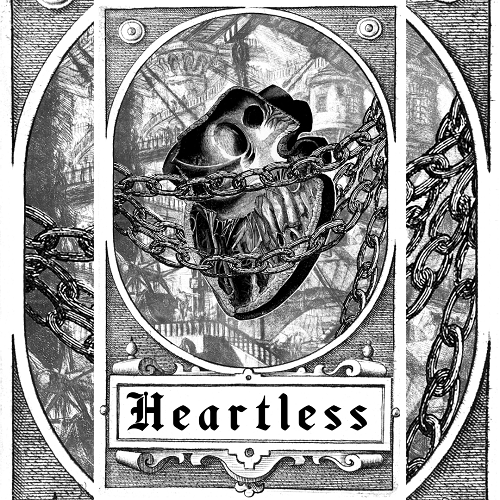
Heartless.

Surprise, it’s a brand new fantasy tale!

What is this?

This is a short story (6k words) about what happens when a wastrel prince takes drastic measures to preserve his wayward love.

It is not a romance. While the story revolves on the axis of a romantic relationship, it does not end in a happily-ever-after. If you are wildly optimistic, it ends in a happy-for-now.

It’s gory, it’s toxic, it’s harrowing. Perfect for the season of All Hallow’s Eve.

Why is this?

Halcyon and Noll have lived in my heart for over a decade. Now they are out in the world for you to read. Enjoy!

Any relation to the Halcyon in Fiorenzo?

Absolutely none, I just like the name.

Where can I read this story?

You can download the epub from my Payhip as well as from my Patreon store.

And as always, thank you for reading.

Musical Accompaniment for Oak King Holly King

What’s the soundtrack for a fae Victorian romance?

The music I listen to while working on stories in this fantastical world has changed from book to book. Originally, when writing Oak King Holly King, I built a playlist of New Age, Celtic, medieval, and folk music that played on repeat for the two years it took to bring Shrike and Wren to life.

You can listen to it on Spotify here.

In between publishing Oak King Holly King and Tales from Blackthorn Briar, I learned that the dungeon synth genre existed. The soundtrack for these stories is almost entirely dungeon synth, particularly Fief, Quest Master, Inlustris, Ulk, Dim, and Dark Vestige.

II by Fief

The Twelve Temples by Quest Master

Stella Splendens by Inlustris

Shellbound by ulk

Steeped Sky, Stained Light by DIM

SONGS FROM SAINT ANDREWS CHAPEL by Dark Vestige


After Tales from Blackthorn Briar, and through dungeon synth, I found what would become one of my favorite bands, Obsequiae.

Obsequiae combines black metal vocals, punk rock drums, and medieval modes on their guitars to create a sound unlike anything else out there. The live recording of their performance at Fire in the Mountains in 2022 is on repeat whenever I annotate Oak King Holly King.

If you’d like your very own annotated copy of Oak King Holly King or Tales from Blackthorn Briar to enjoy alongside this musical accompaniment, all annotated books are 30% off in my Etsy shop now through the end of September.

And as always, thank you for reading.

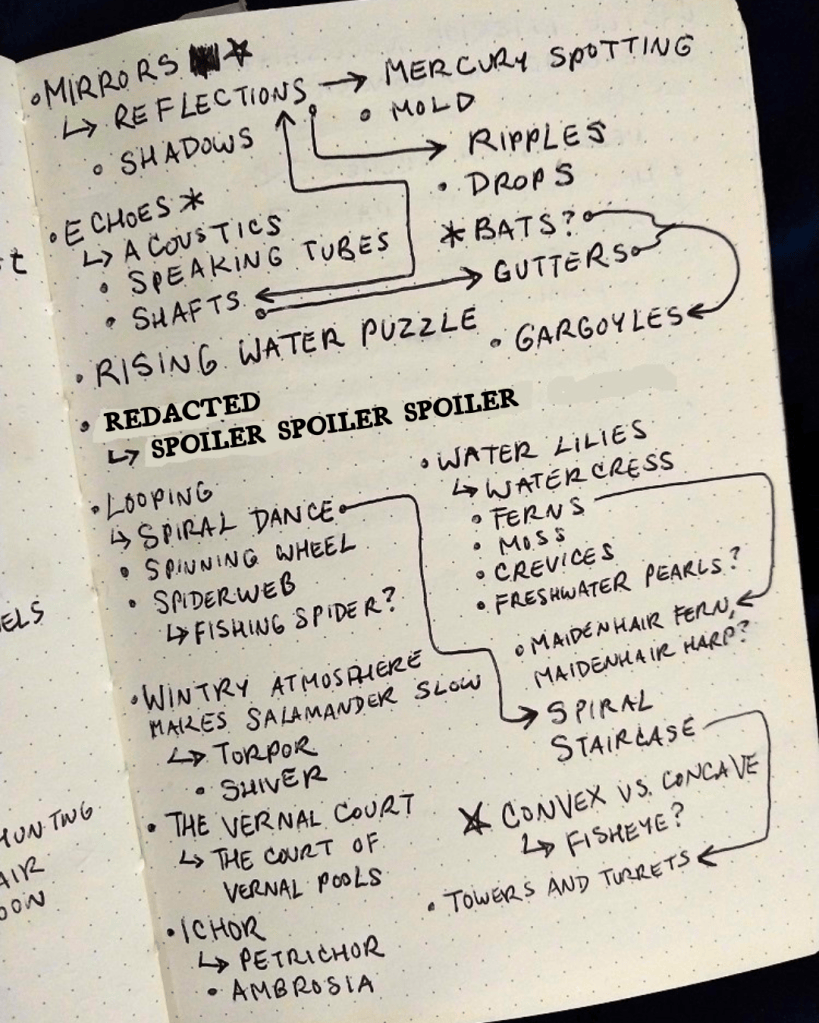
Ambient Word Map – Oak King Holly King IV

Please enjoy these extremely vague spoilers for Oak King Holly King IV.

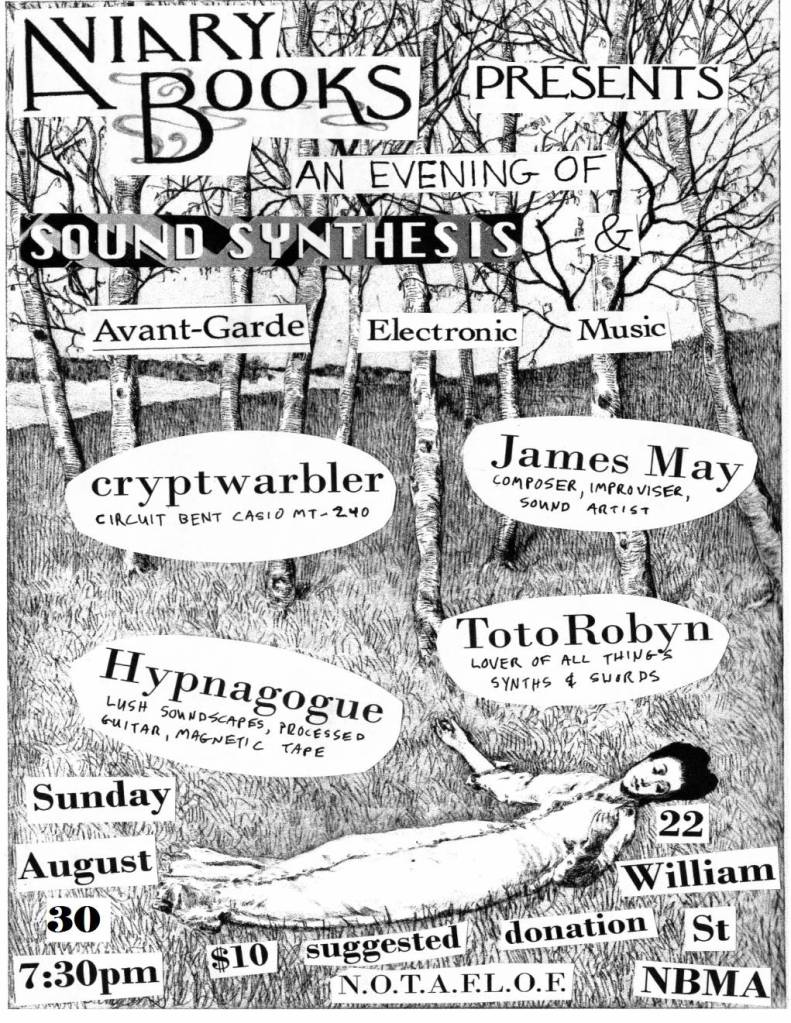
On Sunday, August 30th, I attended an ambient concert at Aviary Books in scenic New Bedford, Massachusetts. This is the word association that resulted during an evening of innovative sounds from TotoRobyn, Hypnagogue, cryptwarbler, and James May. 10/10, would enjoy the ambience again.

In the meantime, you can catch up with all twelve chapters of Oak King Holly King IV available right now on Patreon.

Your Nothwell Newsletter – English Folkloric Liminality in Queer Paranormal Historical Popular Romance

Pride Month is a whirlwind of activity for queer romance authors, and my experience this past June was no exception. Even so, it came with an enormous and wonderful surprise that I could never have anticipated.

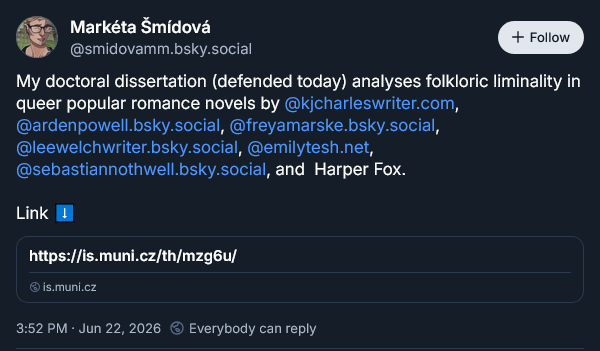
As a big research nerd into history, medicine, botany, and increasingly more obscure fields with every book I write, I cannot begin to express the elation I felt when Dr. Markéta Šmídová tagged me on bsky alongside the illustrious names of KJ Charles, Arden Powell, Freya Marske, Lee Welch, Emily Tesh, and Harper Fox, to announce that they had just successfully defended their doctoral dissertation, promisingly titled, “Kissing for Dear Life in a Dead Land: English Folkloric Liminality in Queer Paranormal Historical Popular Romance.”

In a further extremely generous gesture, their post also links to a free download of said dissertation.

Not since “The Philomena of John Bradmore and its Middle English derivative: a perspective on surgery in late Medieval England” by S.J. Lang have I so swiftly, feverishly, and delightedly read an academic work. It is a fascinating read for anyone interested in queer romantasy, and an incredible honour to be included. Highly recommend checking it out if you’ve enjoyed the oeuvre of any of the authors cited within.

That’s all for this Nothwell newsletter, but keep a weather eye on the horizon for September! And as always, thank you for reading.

—Sebastian

“Where do you get your ideas?”

Answer: There’s a little imp inside my skull and I have to feed it stories otherwise it tears my brain apart.

Answer: Have you ever read a book or watched a film with a great concept but a wretched execution, or wonderful side characters over-looked in favor of bland protagonists, and you find yourself gnashing your teeth over the wasted potential?

Answer: Back in my day TV shows came on at a set hour every week and you had to be there at that time or you missed it and there were commercials at regular intervals and they were unskippable but my childhood brain didn’t like the stories being interrupted so when there was a commercial break I would turn the TV off and pace around for hours writing my own ending to the episode because I did not have the patience to sit around for the five minutes it would take for the Sci-Fi channel to sell me household goods.

Answer: What’s it like to not be tormented by visions?

Answer: When all you have is a hammer, everything looks like a queer romance.

How to get your favorite author to do a signing at your local library or indie bookshop!

  1. Ask your local library or indie bookshop to invite them.
  2. Ask your local library or indie bookshop to invite them.
  3. Ask your local library or indie bookshop to invite them.

Getting your favorite indie author to visit your local library or indie bookshop is a bit like getting a specific guest for your local Comic Con. In my experience most libraries and bookshops (understandably) do not want cold calls from indie authors. As a result, authors really can’t invite themselves to the party. You, the patron, have to want your fave author to do a signing – and more importantly, you have to communicate this want to the library and/or bookshop.

(In a related matter, do you want to see your fave sci-fi/fantasy/spec fic author at your local fan convention? Ask the con to invite them!)

If you want me to come to a particular town or city or event, I am the guy who is probably the least in charge of whether or not that happens. While I very much appreciate all the kind messages asking me to visit your local bookshop, there’s very little I can do about it on my end.

So how do you make it happen?

Ask the people running the thing if it’s possible, and if so, ask them to invite me to apply. (Ask them nicely! Politely! Be kind and be willing to accept “no” for an answer!)

As always, thank you for reading, and I look forward to meeting you soon!

How Do You Pick Your Tarot Deck?

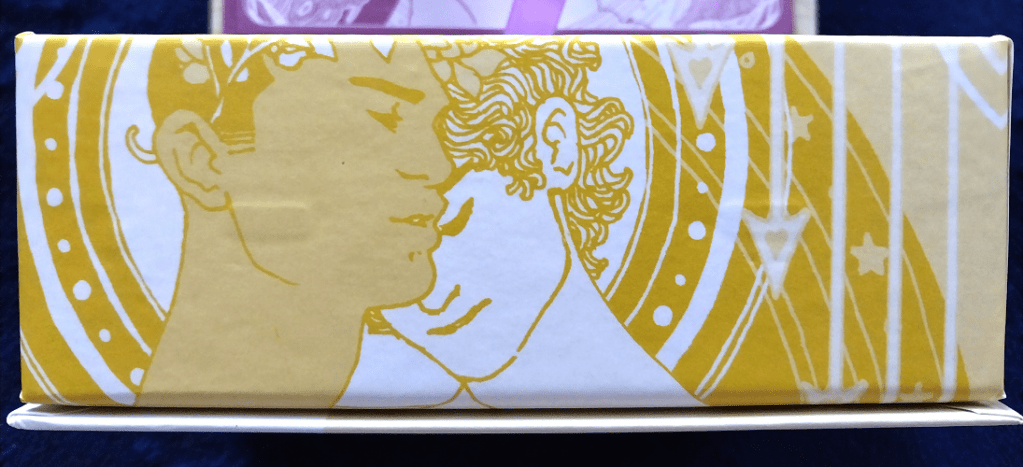
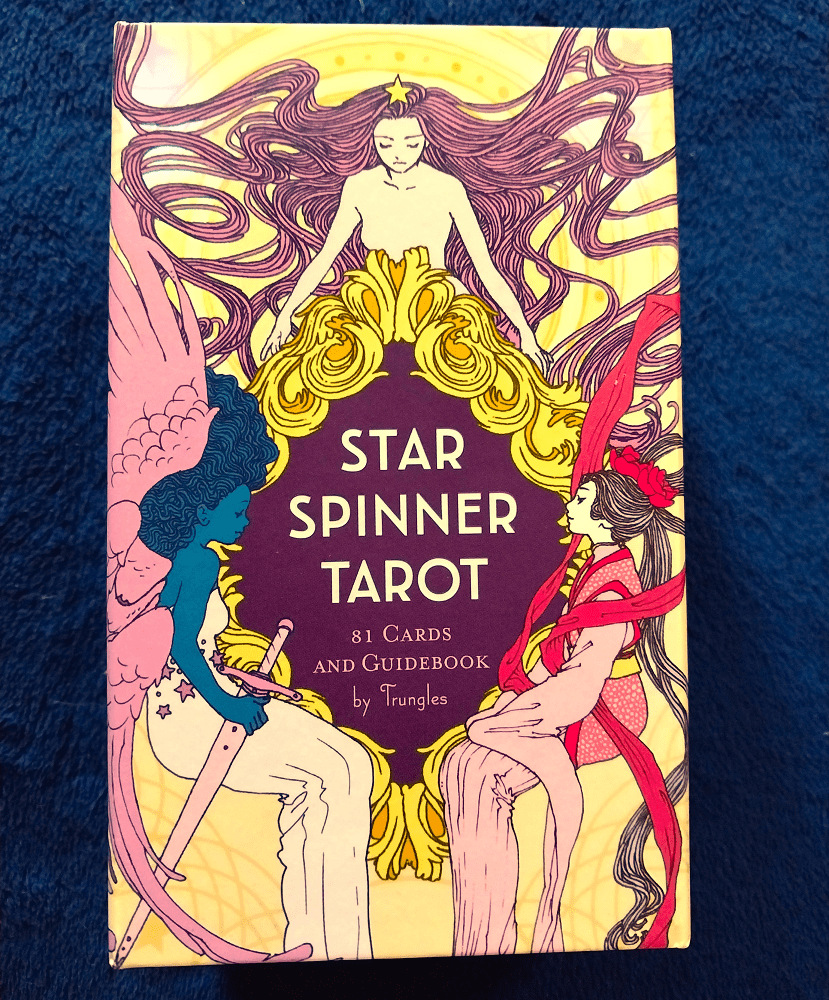
Box art for the Star Spinner Tarot by Trung Le Nguyen.

Let’s talk about the Lovers card.

Once upon a time back in the 2010s, I was eager to learn cartomancy. However, when seeking out a deck of my own, every Lovers card I found featured a man with a woman. Over the course of many visits to New Age shops all across New England, I struggled to find a woman with a woman or a man with a man, much less anyone outside of the gender binary. More than two people? Impossible. Fewer than two people? Unheard of.

So I began asking around the witchy community of the internet for tarot decks with non-heteronormative versions of the Lovers card.

First I received a barrage of unhelpful responses about how a Lovers card depicting a man with a woman was not really heteronormative because the card symbolized balancing the innately opposed forces of feminine vs. masculine. To say I found these explanations annoying would be an understatement. While I myself am binary-identified, I am not stupid enough to believe there are only two genders. Nor am I ignorant enough to suppose that femininity and masculinity are innately warring on a cosmic scale. I cast these insufficient explanations aside and continued my search.

Some more well-intentioned responders gave me recommendations for decks that did not depict the Lovers as humans with genders at all. These decks featured woodland creatures, mushrooms, plants, stars, or still more abstracted imagery. While these decks would be very useful for others, they were still not what I wanted. I didn’t want to deny the Lovers as lovers. I just wanted them to resemble the kind of love I had sought and known in my own experience.

Other slightly more helpful responders recommended erotic queer decks. While I myself enjoy queer eroticism very much—one might even argue I’ve built a career on it—I don’t necessarily want to jerk off to my tarot reading. Additionally, a deck with graphic erotic art, while beautiful, is not the sort of thing one can bring to a party of strangers unless it is an extremely specific kind of party. Thus I continued my quest.

I had begun to despair of ever finding what I sought when, at long last, I heard whispers on a wind of a new deck. It had not yet been printed but the artist had shown some of his work-in-progress and, in addition to the exquisite artwork, he had devised a very particular approach to the Lovers.

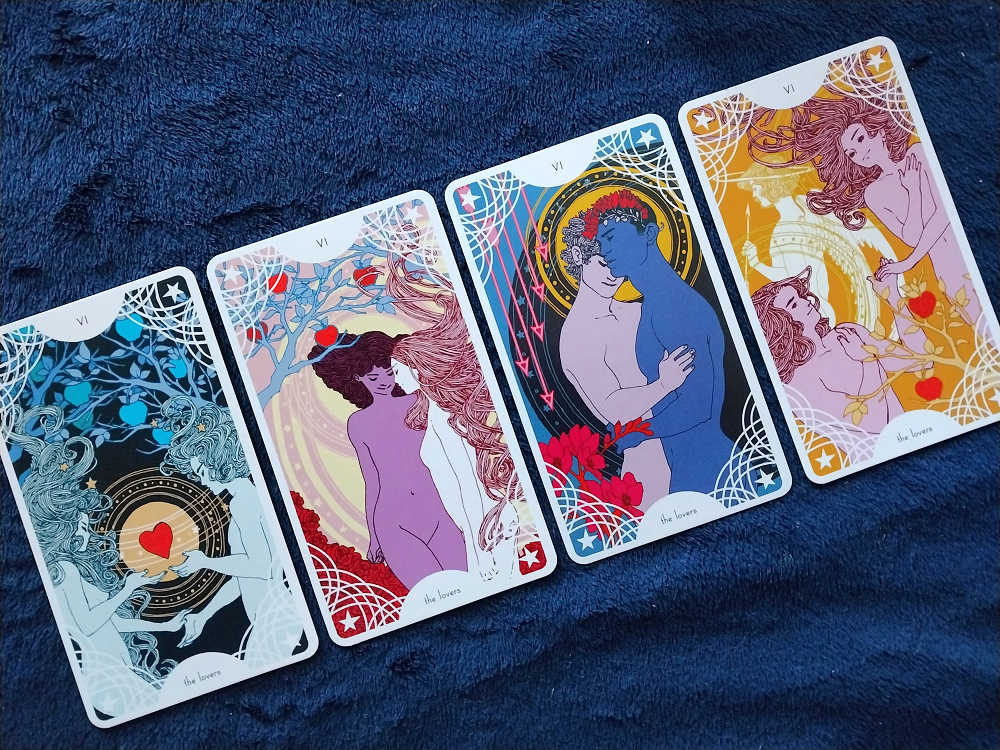
Namely, there would be multiple Lovers.

Rather than a single Lovers card to bear the burden of representing everything I needed, the artist—Trung Le Nguyen, also known as Trungles, a prolific illustrator and author of graphic novels—would create four cards; one with two men, one with two women, one with a man and a woman, and one with three figures. The diviner need merely choose which Lovers card spoke to them, shuffle it in, and draw as they would from any other deck.

With this perfect answer to my plea in the works, I eagerly awaited the release of what would become The Star Spinner Tarot.

Box art for The Star Spinner Tarot by Trung Le Nguyen.

The Star Spinner Tarot came out in March of 2020 and exceeded my astoundingly-high expectations. To describe the art style of the deck as Art Nouveau feels both reductive and insufficient. Le Nguyen has done far more than merely translate the Rider-Waite imagery into an Alphonse Mucha pastiche. While there is an undeniable Art Nouveau influence on the style’s crisp linework and smooth angles, the sheer imagination bursting through the layered imagery is breathtaking to behold, and the skill required to bring this vision to such masterful fruition cannot be overstated. Moreover, Le Nguyen has not fallen into the all-too-common trap of pouring everything into the Major Arcana whilst leaving the Minor Arcana to fend for themselves; every card is given artistic weight, with the result that the Minor Arcana are just as gorgeous and visually rich as the Major Arcana. There is a diversity throughout the deck not only of gender but also of ethnicity and culture.

The deck comes in a magnet-secured box that unfolds with splendid ease. Every corner of it is decorated in still more of Le Nguyen’s art. This box also includes a guidebook authored by Le Nguyen himself, explaining his reasoning behind the chosen imagery and his efforts to remove Orientalism from the iconography, alongside thorough, heartwarming, and gently-encouraging interpretations for each card in the deck.

And the Lovers cards are everything I could’ve hoped for.

Having at last acquired my ideal deck, I could delve into cartomancy in earnest.

One of the results being a particular anthology.

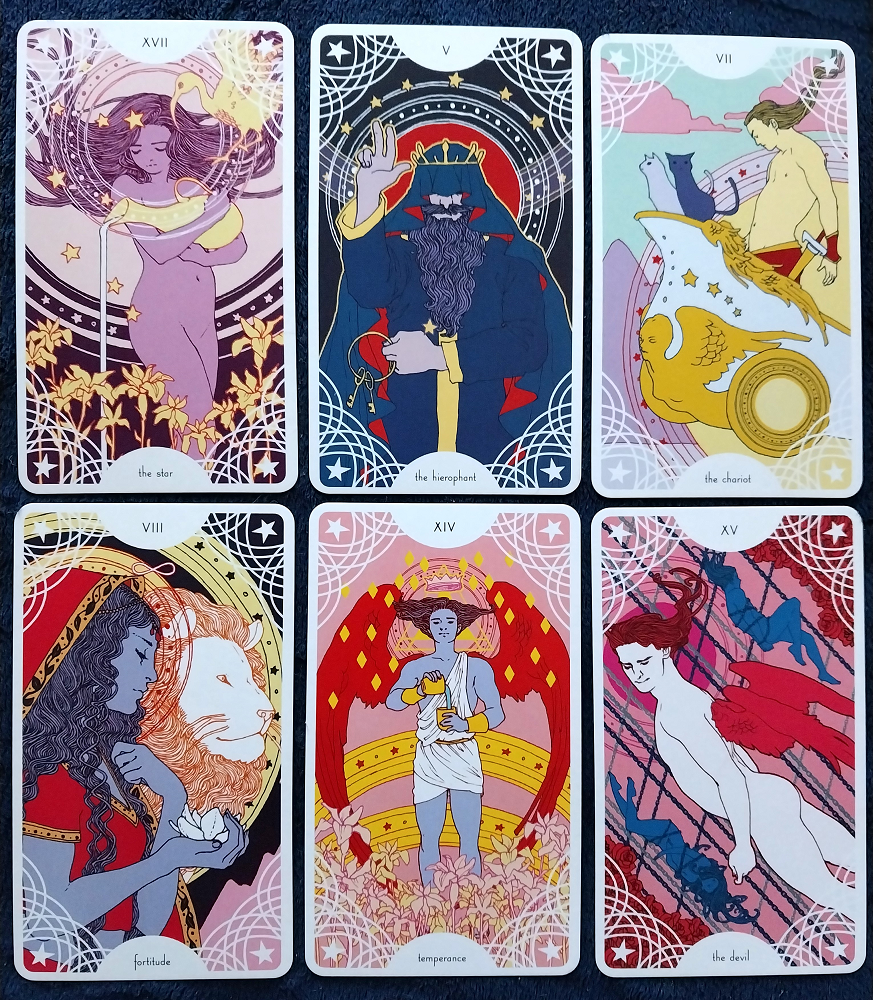
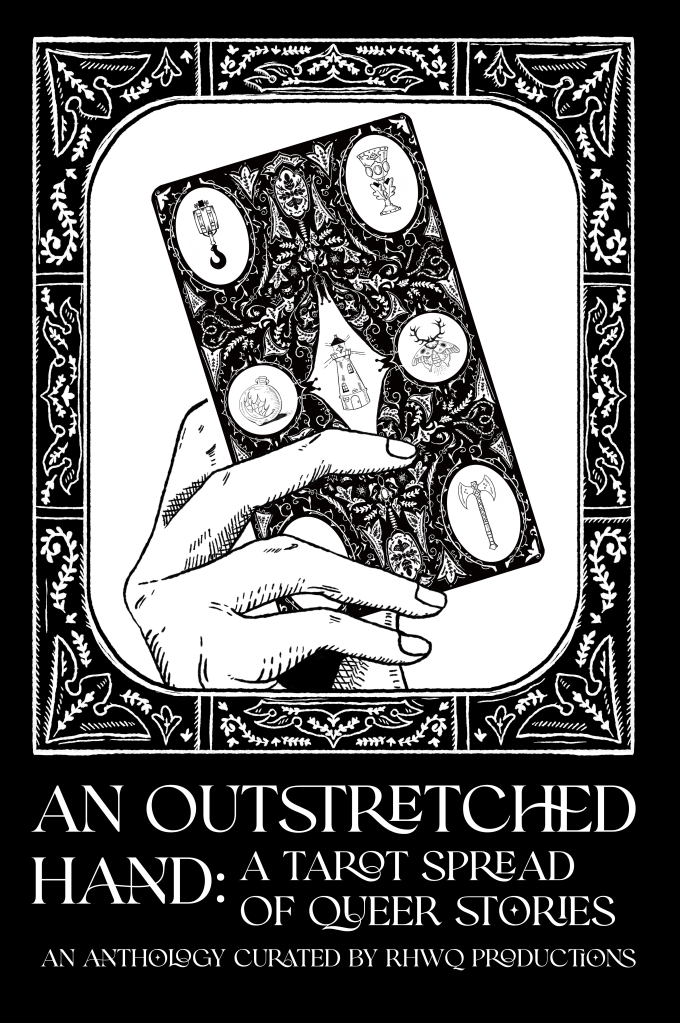
An Outstretched Hand: A Tarot Spread of Queer Stories is a fantasy anthology inspired by the magic of tarot, available now wherever fine books are found. The six tales include…

The Star by Tess Carletta

A lighthouse keeper who influences the fate of her people by wrangling misbehaving stars back into place must remedy her own constellation.

The Hierophant by Carolina Cruz

A knight who was disabled in battle gives up on asking the gods for healing and turns to something dark in the woods for help instead.

The Chariot by RK Ashwick

Two witches vie desperately for a goddess’s blessing—but the fortune they seek might be right in front of them.

Strength by Luna Daye

A warrior is sent to investigate the rumors of a raided village and is forced to face the trauma of his past, and has to battle more than his grief after a terrifying discovery.

Temperance by Noah Hawthorne

A grieving mercenery searches for the tallest mountain to throw himself from, but a mystery and curious folk keep him grounded for a little while longer.

The Devil by Sebastian Nothwell

A repressed Victorian finds fleeting release in a fae courtesan’s arms—until iron chains threaten their growing bond.

Amazon • Apple Books • Barnes & Noble • Books2Read • Bookshop.org • Kobo • Smashwords

Appendicitis: The Narratively Perfect Disease – Hurt/Comfort

Disclaimer: I am not a doctor. None of this is medical advice. We are speaking of appendicitis in a purely fictional context. If you are having symptoms you suspect may be appendicitis please stop reading and seek medical attention from a qualified practitioner immediately.

~

“Four people are sitting around the table talking about baseball, whatever you like.

Five minutes of it, very dull.

Suddenly a bomb goes off. Blows the people to smithereens.

What do the audience have?

10 seconds of shock.

Now, take the same scene. And tell the audience that there’s a bomb under the table and that it’ll go off in 5 minutes.

Now the whole emotion of the audience is totally different. Because you’ve given them that information.

Now that conversation about baseball becomes very vital. Because they’re saying to you, don’t be ridiculous, stop talking about baseball there’s a bomb under there.

You’ve got the audience working.”

— Alfred Hitchcock

~

I hear Alfred Hitchcock talk about Suspense and I think Appendicitis. A bomb strapped under the table that only the audience can see? No—a vestigial organ in everyone’s abdomen.

Continue reading “Appendicitis: The Narratively Perfect Disease – Hurt/Comfort” →

Hurt/Comfort – Why Do We Love This Trope?

“You construct intricate rituals which allow you to touch the skin of other men.”

–Barbara Kruger, Untitled, 1981

~

“In the war film, a soldier can hold his buddy—as long as his buddy is dying on the battlefield. In the western, Butch Cassidy can wash the Sundance Kid’s naked flesh—as long as it is wounded. In the boxing film, a trainer can rub the well-developed torso and sinewy back of his protege—as long as it is bruised. In the crime film, a mob lieutenant can embrace his boss like a lover—as long as he is riddled with bullets. Violence makes the homo-eroticism of many ‘male’ genres invisible; it is a structural mechanism of plausible deniability.”

–Tarantino’s Incarnational Theology: Reservoir Dogs, Crucifixions, and Spectacular Violence. Kent L. Brintnall.

~

(Expanding on this reddit AMA and the Right Here Write Queer podcast episode with Luna Daye, Noah Hawthorne, Sarah Wallace, and S. O. Callahan.)

What is hurt/comfort?

In the simplest terms, hurt/comfort is any scene in a story wherein a character is hurt in some way and subsequently comforted.

Examples of hurt/comfort I’ve enjoyed in fiction include…

Our Flag Means Death, wherein a ferocious pirate captain tenderly looks after his wounded peer, well before any emotional connection has been established between them.

The Terror, wherein a steward nurses his captain through alcohol withdrawals (and—spoiler—is subsequently nursed through scurvy by his captain).

(“Hey, there seems to be a nautical theme here,” you say. Yes. Because of the unique homosocial setting of the Age of Sail removing women from the scene, which forces men to step up into a caretaking role for other men, and also because the isolation of a ship at sea means medical care—including surgery—must occur on location and often at the hands of characters who are already deeply intertwined. Also because I’m the one making this list and I have a problem.)

The trope is particularly popular in fanfiction, for reasons that will be expounded upon later. According to Fanlore, hurt/comfort dates back to the Star Trek fandom of the 1970s. (An earlier term for the trope was “Get ‘em,” as in “attack.” A hurt/comfort fanfic centered around Spock, for example, would be called a “get Spock” story.)

A related term, “whump,” has undergone a curious evolution. Originally it meant a more severe form of hurt/comfort, heavier on the hurt and with less comfort—sometimes even no comfort at all. More recently it has come to be almost synonymous with hurt/comfort; not necessarily because of any changing attitudes towards the trope itself, but simply that tagging systems on most social media platforms struggle to parse the slash in hurt/comfort without breaking the hashtag. (Only very recently has tumblr fixed this issue. Instagram and the like haven’t bothered.) This makes finding hurt/comfort posts on social media extremely difficult. However, since there is significant overlap between hurt/comfort and whump content, users were able to find hurt/comfort content through the whump tag, and so they merged.

In my own works, Fiorenzo has the most hurt/comfort per page; appendicitis, wild animal attack, kidnapping, stabbing, poisoning… the list goes on. Mr Warren’s Profession has its fair share in boiler explosions, burns, broken bones, and sundry others, with bonus pneumonia in its sequel Throw His Heart Over. Hold Fast features horse-riding accidents and gunshot wounds. The Haunting of Heatherhurst Hall has just as much gore as you’d expect from Gothic horror, but probably far more caretaking than most. As for Oak King Holly King, let’s just say, antler-induced migraines—plus hypothermia and still more wild animal attack in the sequel Tales from Blackthorn Briar. It’s fairly obvious that hurt/comfort is my favorite trope and I doubt I’ll ever craft a story without at least a drop of it.

But why?

What makes hurt/comfort so compelling?

For me, hurt/comfort is inextricable from queer romance—and more specifically, from romance between men.

Male characters in Western media generally aren’t permitted to be emotionally vulnerable towards other men. It seems like the only time a man can show weakness is if he’s physically wounded and/or dying.

After a lifetime of absorbing that, the end result is that physical vulnerability and emotional vulnerability go hand-in-hand in my brain.

Furthermore, there’s almost never any catharsis after a man is shown to be wounded in TV/film. We are shown the violence, and we are perhaps even shown the rescue from said violence, but the recovery is limited in scope if it is depicted at all. I find that very unsatisfying. And hurt/comfort is, for me, a satisfying way to dwell in the catharsis that is denied us when we are only shown the “hurt” half of masculine vulnerability.

(This lack of comfort in most media wherein characters are hurt is also why this trope is particularly prominent in fanfiction. Fanfic exists to fill the gaps in existing stories, and comfort is a very common gap.)

To be loved when you are weak, to not have to hide your suffering, to be honest about your pain and have your pain not just witnessed but also sympathized with and empathized with and to the extent that it is possible alleviated, is frankly an exhilarating prospect, and to see it occur in fiction can grant the reader a powerful euphoria.

Hurt/comfort is also very powerful from a technical standpoint as a writer. Your narrative voice can say your characters care about each other. You can even make the characters say it out loud themselves. But nothing will be as effective as showing that care through the characters’ actions, and it is the showing that will make it feel truly real to the reader. And nothing says “I care about you” quite like holding someone’s hair out of their face while they puke, or spoon-feeding them soup while they’re too weak with fever to do for themselves, or picking through the pus and gore to clean their wound and staunch their blood. It’s precisely this unglamorous side of true love that makes it believable. And it’s that believability that compels me far more than a thousand flowery declarations of eternal affection ever could.

What is revealed about a man who tries to keep his walls up but is forced into a position of vulnerability by his circumstances? What might his friend, lover, or even enemy learn of him then? Still more character is revealed in how they react to his plight. If he expects scorn as a reward for what he perceives as a failure of his strength, what would it do to him to receive compassion in its stead? What could this new understanding between them spark?

I write hurt/comfort to answer these questions and to achieve the catharsis denied to me in almost all other media. In a world full of hurt, we all need some comfort.

~

What is an Annotated Book?

If you’re a reader who abhors writing in books, turn back now.

The short definition of an annotated book is a book that contains additional details outside of the original text. This is often seen with reprinted “classics” of the Western literary canon, such as an edition of The Picture of Dorian Gray where the publisher has added footnotes explaining Oscar Wilde’s allusions to history, literature, and in some cases his own biography. Or, in a less illustrious example, my own annotated copy of the Sherlock Holmes novel The Sign of Four by Sir Arthur Conan Doyle, wherein a helpful footnote interrupted a thrilling boat chase to inform me that, “The Thames is a river in London.”*

However, preprinted annotations are not the only valid form of annotating books. Nor, to my mind, are they the most interesting.

Handwritten annotations by everyday readers are a long-standing human tradition which has rapidly increased in popularity of late. Readers have always enjoyed and continue to enjoy putting their own personal touches on their home libraries, including highlighting favorite passages and scribbling notes in the margins.

My grandfather was a voracious reader and annotator. Not only did he underline, asterisk, and write marginal notes in his copy of The Story of English, he also created a handwritten supplemental index at the back of the book. (Presumably the multi-page preprinted index the publishers provided was insufficient for his purposes.)

(Not shown: the obscure 20th century small press religious text wherein he underlined several passages and wrote over and over again in the margins, “Human sacrifice?”)

Another grandfather (not my own) created a singular annotation in his copy of Moby-Dick that nonetheless resonated with thousands of users on tumblr dot com.

More recently, annotating books has proved particularly popular in the Dark Academia subculture. The hobby reinforces many of the subculture’s values at the intersection of literature, curating a personal library, and following advice straight from Donna Tartt’s The Secret History: “It is is better to know one book intimately than a hundred superficially.”**

In the case of most public domain literature like Melville or Wilde, the reader is limited to either their own annotations or the annotations of whatever experts a given publishing company chooses to hire to produce preprinted notes for their particular special edition. We do not have the option of annotations from Melville or Wilde themselves as they are regrettably deceased.

This is not true of most books published in the 21st century. For a modern book with a living author, it’s now possible to attain handwritten annotations from the author themself on the text.

For example—in my annotations for Oak King Holly King, I explore the paragraphs of historical research behind single lines of dialogue, the queer connections between Chartism and the 1381 Peasant’s Revolt, and the secret origins of the ambassador (alias the spiderweb fae), alongside highlighting my own favorite passages and sundry other notes.

As well as a personalized autograph!

I’ve done the same for all my books, including…

Mr Warren’s Profession, wherein I divulge the symbolism in the menu of the Worst Dinner Party Ever and tell all about Rowena’s discreet sapphic flirtation methods.

Throw His Heart Over, wherein I get real nerdy about art history.

The Haunting of Heatherhurst Hall, wherein I wax poetical about New England folklore and sapphic literature.

Hold Fast, wherein I really let loose on the Moby-Dick and Poe allusions while tipping my hand when it comes to my fave characters.

Fiorenzo, wherein I finally (finally!!!) explain why the city is called Halcyon and why Fiore’s shipwrecked home is called the Kingfisher.

Tales from Blackthorn Briar, wherein I indulge in medieval trivia and rejoice in giving Mr Grigsby and Daniel the happily-ever-afters they so richly deserve.

…all of which you can find available for discerning and dedicated readers on my Etsy.

~

*Which in terms of Captain Obvious facts comes second only to my college oceanography textbook’s helpful tip: “The Indian Ocean is so named for its proximity to the subcontinent of India.”

**Whether this advice, like the bulk of the novel itself, is meant to be satirical… who can say.