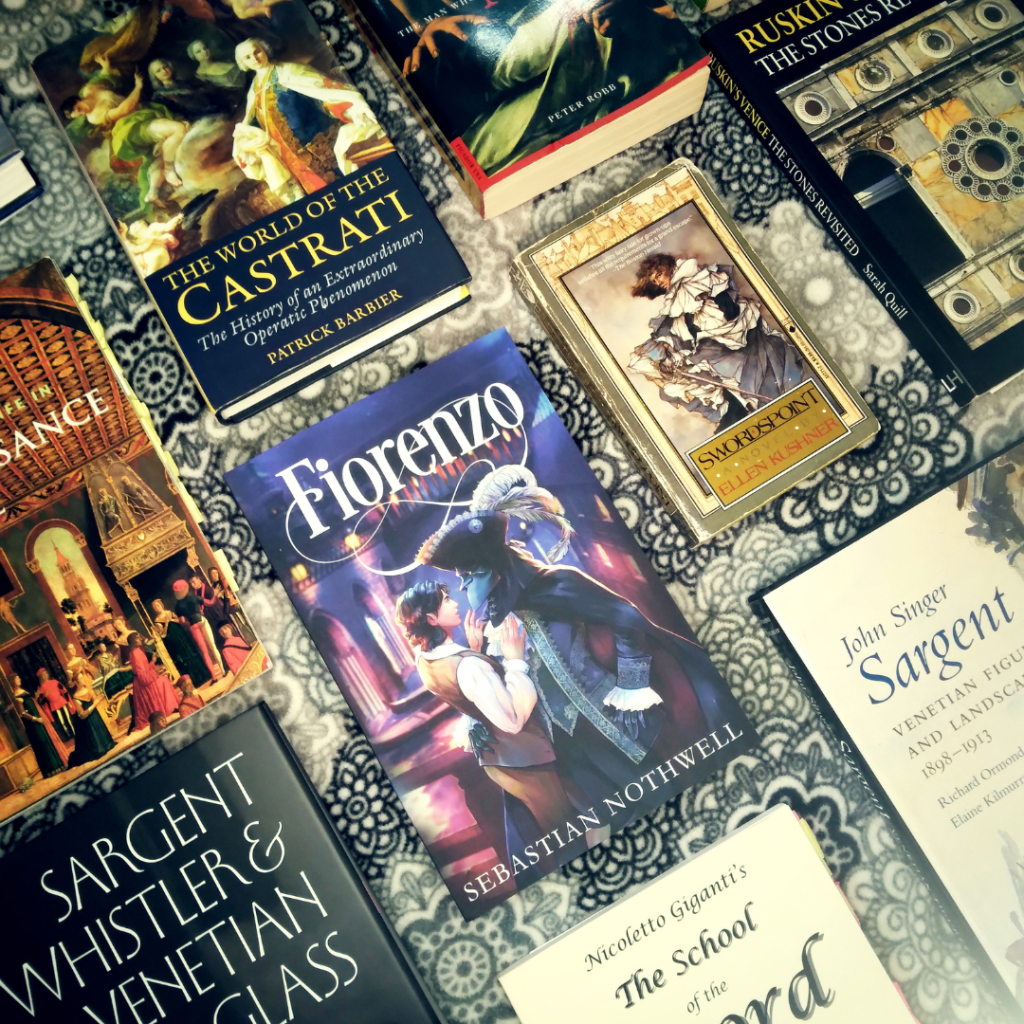
Fiorenzo Bibliography + Paperback

FIORENZO is a queer fantasy-of-manners romance featuring hurt/comfort, swordplay, and a happily-ever-after. And it’s finally out in paperback! Shown here with some of the books that inspired it.

The World of the Castrati by Patrick Barbier
Not just a thorough examination of individual castrati lives but also the operatic world that created them. Highly recommended, even (or especially) if you know nothing of opera.

Nicoletto Giganti’s The School of the Sword
A swordfighting guide by a fencing master of Renaissance Venice. This book, combined with As You Wish (see below) and Vico Ortiz’s Fencing 101 class proved absolutely essential to making the fight scenes in Fiorenzo possible.

M: The Man Who Became Caravaggio by Peter Robb
Come for the art history lesson about a queer Renaissance painter, stay for the tennis court castration duel.

Art and Life in Renaissance Venice and Private Lives in Renaissance Venice by Patricia Fortini Brown
While the general history of Venice was necessary (see below), the more specific focus of Brown’s books provided absolutely invaluable insight into the the day-to-day habits of Venice’s historical citizens.

John Singer Sargent: Venetian Figures and Landscapes, 1898-1913
Sargent’s mind-blowing skill with oil portraits is well known, but his watercolour sketches of cityscapes and Venice architecture are truly astounding in their mastery of light and form. Seeing the city through his eyes over a hundred years ago was wildly inspiring.

Sargent, Whistler & Venetian Glass
This was an incredible traveling exhibit of Venetian glassware, lace, and other amazing examples of skilled craft alongside paintings by American artists who drew inspiration from Venice in the late 19th and early 20th centuries. I had the good fortune to catch it as it came through Mystic Seaport in Connecticut. It also included an actual Venetian gondola (dry-docked, no felze) which gave me an invaluable sense of just how absolutely huge those things are.

As You Wish: Inconceivable Tales from the Making of The Princess Bride by Cary Elwes and Joe Layden
Invaluable insight into the training, choreography, and filming process for one of the greatest swordfighting scenes in cinematic history.

The Princess Bride by William Goldman
It’s a swordfighting romance. Enough said.

Swordspoint by Ellen Kushner
It’s a queer swordfighting romance. Enough said. (Although I have said far more.)

Ruskin’s Venice: The Stones Revisited by Sarah Quill
Venice through the eyes of a Victorian.

Venice: A New History by Thomas F. Madden
A general history of Venice was essential in creating Halcyon.

~

FIORENZO is a queer fantasy-of-manners romance featuring hurt/comfort, swordplay, and a happily-ever-after. Available now wherever fine books are found!

Amazon • Apple Books • Barnes & Noble • Bookshop.org • Kobo • Payhip • Smashwords

Autism Representation (Accidental and Deliberate)

(This post inspired by a recent AMA on the MM_RomanceBooks subreddit.)

Mr Warren’s Profession is my first novel.

Perhaps because I felt insecure and thought I had something to prove, I was determined to depict two allistic protagonists. Then I handed it off to an allistic friend for a beta read, who said, “Wow! It’s so cool how you’re doing autistic representation by having two autistic characters in a romance together!”

Which told me I was even worse at masking than I’d thought.

Continue reading “Autism Representation (Accidental and Deliberate)” →

How do you defeat writer’s block?

Everyone has those days when they show up and sit down to write and their brain, for whatever reason, just says, “I can’t.”

For years I didn’t have a solution to this problem beyond beating my head against the keyboard until a few paltry words fell out.

Then, as I walked away from another disappointing writing session with my brain chanting, “I can’t, I can’t, I can’t…” I stopped and said to myself, “Okay. I can’t write today. But if I could, what would I write?”

And suddenly there burst forth a flood of fresh ideas, dialogue, and fully-formed prose that sent me scurrying back to my keyboard to write it all down.

Rather than arguing with my insecurities and defeatism, I’ve found that allowing myself to have those feelings rather than denying them – and following up with the gentle question of, “What if we could, what would we do?” – can trick my brain into working again.

Will this work for you? I don’t know. You don’t have my brain and I don’t have yours. But for me, tricking myself into treating it as a thought exercise rather than wallowing in personal failure has instantly unblocked me more times than I can count.

What about you? How do you defeat writer’s block?

The Ballad of Daniel Durst, or; What’s in a Name?

Some character names come unbidden. Others are agonized over.

For Aubrey and Lindsey of Mr Warren’s Profession, it was very simple. I have a lifelong fascination with the arbitrary gendering of names and how a name’s gender can change throughout history. Many names we consider “feminine” today were often “masculine” in earlier centuries. The name Aubrey, for example, was used almost exclusively for boys until the song “Aubrey” by Bread hit the radio in 1973. The lyrics even remark upon the name being unusual for a girl.

And Aubrey was her name
A not so very ordinary girl or name
But who’s to blame?

Cue millions of girls born throughout the 70s and 80s getting the name Aubrey.

But before Bread, there was Beardsley. Specifically Aubrey Beardsley, a late Victorian artist who leant his pen-and-ink talents to illustrating, among other things, Oscar Wilde’s Salome. It is in his honour that Aubrey Warren is named Aubrey.

With Aubrey settled, his soulmate still required a name. I ran down my list of Victorian masculine names that had since leapt over to femininity and settled on Lindsey. Simple and satisfying.

For Hold Fast, I wanted to continue my habit of granting my masculine heroes names which had shifted from 19th century masculinity to 20th and 21st century femininity. Evelyn, absolutely unapologetic about who and what he is, received a name now considered unambigiously feminine. Morgan, however, keeping his true desires hidden not just from the world around him but also arguably from himself, received a name that still retains its gender ambiguity.

The protagonists of The Haunting of Heatherhurst Hall received the same treatment in reverse. The name Catherine has (to the best of my knowledge) always been considered feminine. Kit, however, is a nickname fit for anyone regardless of gender. And the genderless ambiguity of Alex as a nickname for Alexandra, Alexander, and any variation thereof, is almost a cultural meme.

And now we come to Oak King Holly King.

I struggled for ages with what to call the heroes of Oak King Holly King. One was a mortal clerk, the other a fae warrior. I knew I wanted the fae to have a name from the natural world. Beyond that I was stumped.

After hours of deliberation I finally decided I would give one character the name Wren, it being both a delightful bird and also a common enough given name for humans.

Unfortunately I originally assigned it to the fae.

It felt wrong from the start. Yes, the fae was fierce like a wren. But beyond that it didn’t sit right. And I still had no name for his mortal counterpart.

One morning, tearing my hair out over my laptop, I realised that if Wren was a good name for a human in my world, then it would probably suit a Victorian mortal. So I slapped the name Wren onto my mortal clerk and it stuck. Suddenly his character clarified; a wee speckled figure who appeared docile at first glance but would loudly and fiercely defend itself and its territory at the slightest provocation.

And since I already had a bird theme going, it seemed only natural to continue it and call the fae Shrike. This likewise gave both character and story the vital direction they’d lacked. An established method of attack (skewering), a particular appearance (masked), and a preferred habitat (thorns).

Naming the characters unstuck the story’s wheels and allowed it to roll out into the book you know now. Secondary characters came still easier. Daniel’s name is a reference to the BBC’s 2012 miniseries adaptation of The Mystery of Edwin Drood by Charles Dickens. In a blink-and-you’ll-miss-it moment where the camera pans over the sign beside Mr Grewgious’s door, it reveals his clerk’s name as Daniel Bazzard. (Dickens himself never bothered to grant Bazzard a given name). Sukie is even more straightforward; I named her after my favorite character from Gilmore Girls.

I delved back into the world of Oak King Holly King to write its sequels in Tales from Blackthorn Briar. Daniel would finally be the protagonist of his own story. As I began writing The Ballad of Daniel Durst, I realised I knew Sukie was a nickname for something, but had no idea which name it came from.

Enter Behind the Name, one of my favorite websites for researching and collecting names for characters.

Looking up Sukie on Behind the Name revealed it was a nickname for Susan, derived from the Biblical name Susanna. In the story of Susanna and the Elders, the innocent Susanna is accosted by two lecherous old men. When she refuses them, they accuse her of adultery in revenge. She is arrested and about to be executed when a young man speaks up and demands her accusers be questioned. The elders are interrogated separately, which reveals a massive hole in their false story; one claims Susanna met her fictional lover beneath a mastic tree, and the other claims to have seen her with her fictional lover beneath an oak. As Wikipedia puts it:

“The great difference in size between a mastic and an oak makes the elders’ lie plain to all the observers. The false accusers are put to death, and virtue triumphs.”

Why repeat all this? Because the young man who spoke up in Susanna’s defense was named Daniel.

I had no idea of this connection when I originally named and wrote these characters. In retrospect it feels like fate. Their roles in Oak King Holly King and The Ballad of Daniel Durst are reversed; it is Sukie who helps rescue Daniel from the unwelcome advances of a lecherous elder. And through that rescue both Sukie and Daniel are able to find their happily-ever-after with each other.

~

Tales from Blackthorn Briar is the sequel to Oak King Holly King, featuring hurt/comfort and many happily-ever-afters – available now wherever fine books are found!

Shrike, the fae Butcher of Blackthorn, and Wren Lofthouse, a mortal Victorian clerk, are bound together by love and fate. Their continued adventures (and those of their friends) are told in this collection of fantastical tales following the story of Oak King Holly King, including…

Mabon
• Wherein Shrike and Wren repay their debt to the Court of Hidden Folk.

Mr Grigsby’s Clerk
• Wherein Mr Grigsby finds a replacement for Wren – and perhaps more than he bargained for.

Jack in the Green
• Wherein a certain Horse Guard wanders into Blackthorn Briar.

Winter Solstice
• Wherein the Holly King surrenders to the Oak King.

The Holly King’s Peril
• Wherein Wren and Shrike discover danger in the wilds of the Fae Realms.

The Ballad of Daniel Durst
• Wherein Daniel embarks on his authentic life in a bold new land.

Amazon • Apple Books • Barnes & Noble • Kobo • Scribd • Smashwords

New Cover Reveal! Mr Warren’s Profession

     “It took some time for me to bring myself to try reading just a sample of this novel. The reason being, the cover page is so awful and ugly. The art work is just totally off-putting. It’s as if the publisher deliberately is trying to turn off readers. HOWEVER, the novel is wonderfully written. It is such an unexpected surprise that I would unequivocally recommend this novel to all.”
               — J Kevin Barry

     “It is a really great book. Disregard the cover and try it. […] I wouldn’t be the first to the mention the cover. I accept it has a quaintness, but I am not partial to to the artwork. I didn’t like it before reading the story, and as such, went into this not expecting much from the story other than a light read. Instead, I was totally charmed.”
               — Reflection

     “like i thought the cover looked kinda goofy so i was a little reluctant to start, but i’m so glad i trusted the premise and got started on it because i got totally hooked and binged most of it in two days.”
               — The Knights Who Say Book

     “Ignore the Cover, Read the Book! This is a book which I passed by several times because of the cover.”
              — Bo

     “I will say though that i nearly did not read it. shallow as I am, the book cover was not appealing. just goes to show, never judge a book by its cover…or something like that…”
              — Patdbooks

     “I thought the cover was a bit off putting – Mr Warren looks like an unattractive gnome!”
                — Sally

     “Although others like the cover art, I found it distracting because both men are supposedly far more attractive than this is.”
               — Rhode

     “Truth be told – DON’T judge this book by its cover! […] I rather like the cover art and understand why it’s used, but I add the disclaimer at the beginning of this review because I can imagine (perhaps in error) that some potential readers might interpret the style as frivolous, too old-school, as indicating that the book is a parody or even conservative.”
                — R E

     “This book first attracted my attention when I saw it ‘compared’ (associated?) with North and South by Elizabeth Gaskell. I love that book and the idea of an m/m version of it was so intriguing, that not even Mr Warren’s Profession’s cover could dissuade me from giving this a try.”
               — Elena

     “Terrible cover, great book.”
              — Jane Harper

It is a truth universally acknowledged that when so many otherwise positive reviews mention how much they hate the book’s cover, the author might do well to consider changing it.

Mr Warren’s Profession is my first published novel. When I sent it out into the world, I knew absolutely nothing about cover design. I think that much is evident from the typography. I did it myself, and boy howdy, it shows. (Note to Sebastian of the past: adding a white drop shadow will not fix black text over a black top hat.)

mr_warrens_profession

And so, in the hopes that readers might be able to recommend the book without a cover caveat, I contacted two talented professionals to help fix the issue.

The first, Jann of Thistle Arts Studio, is a fantastic painter. You can see further examples of his work on his Instagram, Patreon, and Etsy. (Warning: NSFW!) You’ll see more of it when Oak King Holly King is finally released. But for now, he has created a brand new cover painting for Mr Warren’s Profession.

The second, Kelley of Sleepy Fox Studios, is a mastermind of cover composition and typography. You’ve already seen her work on the cover for Hold Fast, which received a quiet redesign about a year ago. You’ll see it again when Oak King Holly King is finally released, and you’ll see it very shortly on the brand new cover design for Mr Warren’s Profession.

And now, without further ado: the new cover. I do hope you approve, and that Aubrey and Lindsey are finally as handsome in pictures as they are in words.

Continue reading “New Cover Reveal! Mr Warren’s Profession” →

“A Happy Ending Was Imperative”; what romance means for the LGBT+

“A happy ending was imperative. I shouldn’t have bothered to write otherwise.”

— E. M. Forster, Maurice, Terminal Note

Romance as a genre has two simple prerequisites. First, that the central plot of the story must revolve around a romantic relationship. Second, it must have a happy ending—at least happy-for-now, if not happily-ever-after.

These two prerequisites are absent from most fiction about the LGBT community.

Mainstream LGBT fiction, particularly literary fiction and YA fiction, is often praised for its “realism.” “Realism,” in this case, is code for “ends badly.” (For more on the realism of HEAs in historical romance specifically, please check out KJ Charles’s excellent post, Historical Romance: Who Gets the HEA.)

In the best case scenario, if a LGBT couple exists at all, they will break up before the end of the story. In the more common scenario, at least one of the LGBT characters dies. TVTropes calls this phenomenon “Bury Your Gays”—and yes, it happens often enough to have a trope name all its own.

E. M. Forster observed this phenomenon as well in his Terminal Note to Maurice. Maurice is a novel with a very simple story; a man who is attracted to men falls in love with a particular man and they live happily ever after. Though Forster began writing the novel in 1913 and finished it 1914, by the time he wrote its Terminal Note in 1960 it remained unpublished and unread by all except a few of his close friends. The reason for this, in his own words, is the happy ending—his motivation for writing the book in the first place.

While the United Kingdom rolled back the death penalty for sodomy in 1861 (changing the punishment to mere life imprisonment), the Labouchere Amendment of 1885 expanded the crime of homosexuality to include any “indecent acts” between men—with an absurdly low burden of proof. Every token of affection between men was now punishable by two years of hard labor in prison.

Homosexuality remained a criminal offense in the United Kingdom until 1967—seven years after E. M. Forster wrote the Terminal Note for Maurice. Maurice itself wasn’t published until after the author’s death in 1971. Because of the legal status of homosexuality in England at that time, no publisher would touch Maurice before then, even though its author had already produced such literary feats as A Room with a View and A Passage to India.

Or, in E. M. Forster’s own words:

“If it ended unhappily, with a lad dangling from a noose or with a suicide pact, all would be well, for there is no pornography or seduction of minors. But the lovers get away unpunished and consequently recommend crime. […] the only penalty society exacts is an exile they gladly embrace.”

On the few occasions that LGBT characters exist in fiction, they are even more rarely the heroes. Throughout the 20th century they were most often cast as villains, with a trend towards comic-relief sidekick at both the beginning and end of that century, if they appeared at all. Their romance, assuming it exists in-text and is not merely divulged through the author’s Twitter post-publication, is by no means central to the story, may be easily deleted for homophobic markets, and has little to no effect on the character’s life, much less the plot.

Only recently—and by “recently,” I mean “within the last five years,” has the tide begun to turn.

The romance genre helps turn this tide. After all, a romantic relationship must be the core of a romance novel. If one writes a gay romance, one cannot merely hint that the heroes are romantically interested in each other. It must be readily apparent to the reader, otherwise there is no story.

Likewise, a romance must have a happy ending. Therefore, if we continue with our example of a gay romance, neither hero can die at the end. Nor can they deny they ever felt any attraction to each other. They cannot break up. They cannot commit suicide. They must continue on living together in romantic bliss—or, as E. M. Forster put it,

“I was determined that in fiction anyway two men should fall in love and remain in it for the ever and ever that fiction allows, and in this sense Maurice and Alec still roam the greenwood.”

And, despite ongoing persecution from the outside world, there is a great wealth of historical evidence in favor of LGBT happily-ever-afters.

Edward Carpenter and George Merrill, for example, were not only life partners but gay rights activists in the late 19th and early 20th centuries. Neither man went to prison for “indecent acts,” despite their living together as a couple deeply in love—possibly they escaped such persecution due to their self-imposed exile from society on their shared farm. They were together for 37 years, from their first meeting in 1891 until George Merrill’s death in 1928. It is their real-life love story that inspired E. M. Forster to write Maurice—and Forster’s longing, as a gay man, for a happily-ever-after of his own that demanded Maurice end in the same bliss.

Much like Forster, I don’t see the point in writing if I can’t give my protagonists a happy ending.

My personal goal, as an author, is to keep writing happily-ever-afters for LGBT characters until their number equals all the LGBT tragedies and all the straight happily-ever-afters combined.

I recognize that this is an unlikely goal, and so will content myself with writing until my hands fall off.

~

An earlier version of this article appeared in the Rhode Island Romance Writers monthly newsletter.