How to get your favorite author to do a signing at your local library or indie bookshop!

  1. Ask your local library or indie bookshop to invite them.
  2. Ask your local library or indie bookshop to invite them.
  3. Ask your local library or indie bookshop to invite them.

Getting your favorite indie author to visit your local library or indie bookshop is a bit like getting a specific guest for your local Comic Con. In my experience most libraries and bookshops (understandably) do not want cold calls from indie authors. As a result, authors really can’t invite themselves to the party. You, the patron, have to want your fave author to do a signing – and more importantly, you have to communicate this want to the library and/or bookshop.

(In a related matter, do you want to see your fave sci-fi/fantasy/spec fic author at your local fan convention? Ask the con to invite them!)

If you want me to come to a particular town or city or event, I am the guy who is probably the least in charge of whether or not that happens. While I very much appreciate all the kind messages asking me to visit your local bookshop, there’s very little I can do about it on my end.

So how do you make it happen?

Ask the people running the thing if it’s possible, and if so, ask them to invite me to apply. (Ask them nicely! Politely! Be kind and be willing to accept “no” for an answer!)

As always, thank you for reading, and I look forward to meeting you soon!

How Do You Pick Your Tarot Deck?

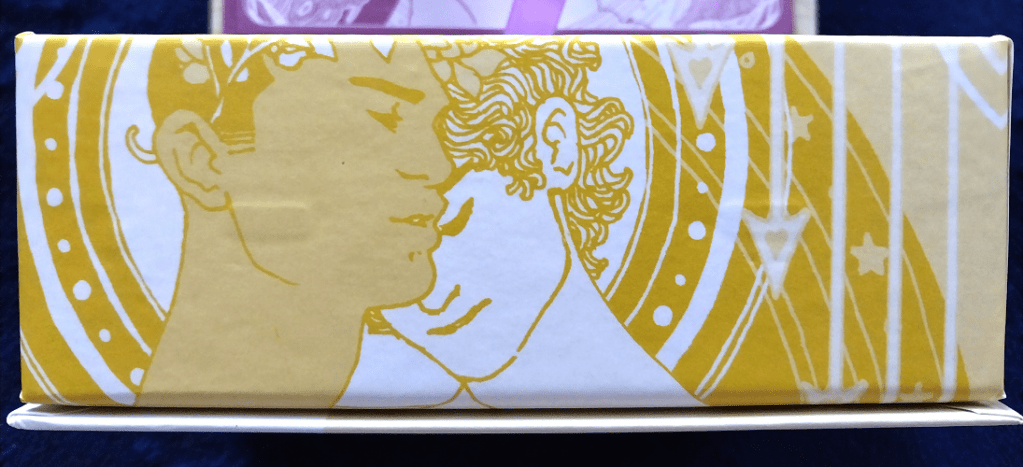
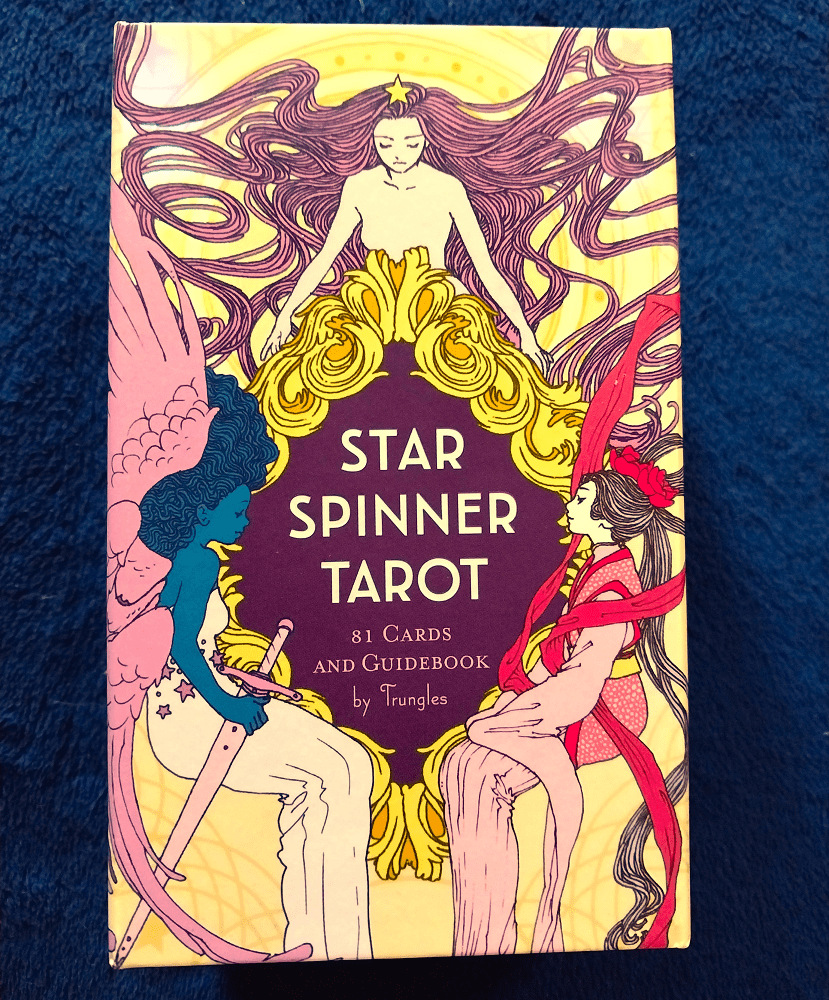
Box art for the Star Spinner Tarot by Trung Le Nguyen.

Let’s talk about the Lovers card.

Once upon a time back in the 2010s, I was eager to learn cartomancy. However, when seeking out a deck of my own, every Lovers card I found featured a man with a woman. Over the course of many visits to New Age shops all across New England, I struggled to find a woman with a woman or a man with a man, much less anyone outside of the gender binary. More than two people? Impossible. Fewer than two people? Unheard of.

So I began asking around the witchy community of the internet for tarot decks with non-heteronormative versions of the Lovers card.

First I received a barrage of unhelpful responses about how a Lovers card depicting a man with a woman was not really heteronormative because the card symbolized balancing the innately opposed forces of feminine vs. masculine. To say I found these explanations annoying would be an understatement. While I myself am binary-identified, I am not stupid enough to believe there are only two genders. Nor am I ignorant enough to suppose that femininity and masculinity are innately warring on a cosmic scale. I cast these insufficient explanations aside and continued my search.

Some more well-intentioned responders gave me recommendations for decks that did not depict the Lovers as humans with genders at all. These decks featured woodland creatures, mushrooms, plants, stars, or still more abstracted imagery. While these decks would be very useful for others, they were still not what I wanted. I didn’t want to deny the Lovers as lovers. I just wanted them to resemble the kind of love I had sought and known in my own experience.

Other slightly more helpful responders recommended erotic queer decks. While I myself enjoy queer eroticism very much—one might even argue I’ve built a career on it—I don’t necessarily want to jerk off to my tarot reading. Additionally, a deck with graphic erotic art, while beautiful, is not the sort of thing one can bring to a party of strangers unless it is an extremely specific kind of party. Thus I continued my quest.

I had begun to despair of ever finding what I sought when, at long last, I heard whispers on a wind of a new deck. It had not yet been printed but the artist had shown some of his work-in-progress and, in addition to the exquisite artwork, he had devised a very particular approach to the Lovers.

Namely, there would be multiple Lovers.

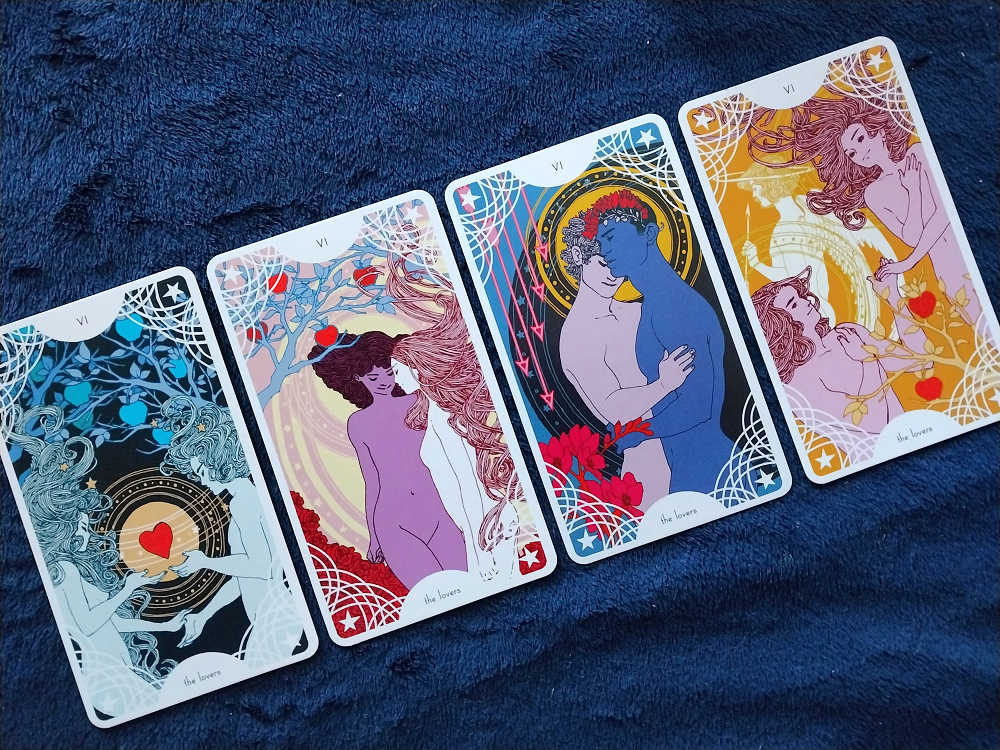
Rather than a single Lovers card to bear the burden of representing everything I needed, the artist—Trung Le Nguyen, also known as Trungles, a prolific illustrator and author of graphic novels—would create four cards; one with two men, one with two women, one with a man and a woman, and one with three figures. The diviner need merely choose which Lovers card spoke to them, shuffle it in, and draw as they would from any other deck.

With this perfect answer to my plea in the works, I eagerly awaited the release of what would become The Star Spinner Tarot.

Box art for The Star Spinner Tarot by Trung Le Nguyen.

The Star Spinner Tarot came out in March of 2020 and exceeded my astoundingly-high expectations. To describe the art style of the deck as Art Nouveau feels both reductive and insufficient. Le Nguyen has done far more than merely translate the Rider-Waite imagery into an Alphonse Mucha pastiche. While there is an undeniable Art Nouveau influence on the style’s crisp linework and smooth angles, the sheer imagination bursting through the layered imagery is breathtaking to behold, and the skill required to bring this vision to such masterful fruition cannot be overstated. Moreover, Le Nguyen has not fallen into the all-too-common trap of pouring everything into the Major Arcana whilst leaving the Minor Arcana to fend for themselves; every card is given artistic weight, with the result that the Minor Arcana are just as gorgeous and visually rich as the Major Arcana. There is a diversity throughout the deck not only of gender but also of ethnicity and culture.

The deck comes in a magnet-secured box that unfolds with splendid ease. Every corner of it is decorated in still more of Le Nguyen’s art. This box also includes a guidebook authored by Le Nguyen himself, explaining his reasoning behind the chosen imagery and his efforts to remove Orientalism from the iconography, alongside thorough, heartwarming, and gently-encouraging interpretations for each card in the deck.

And the Lovers cards are everything I could’ve hoped for.

Having at last acquired my ideal deck, I could delve into cartomancy in earnest.

One of the results being a particular anthology.

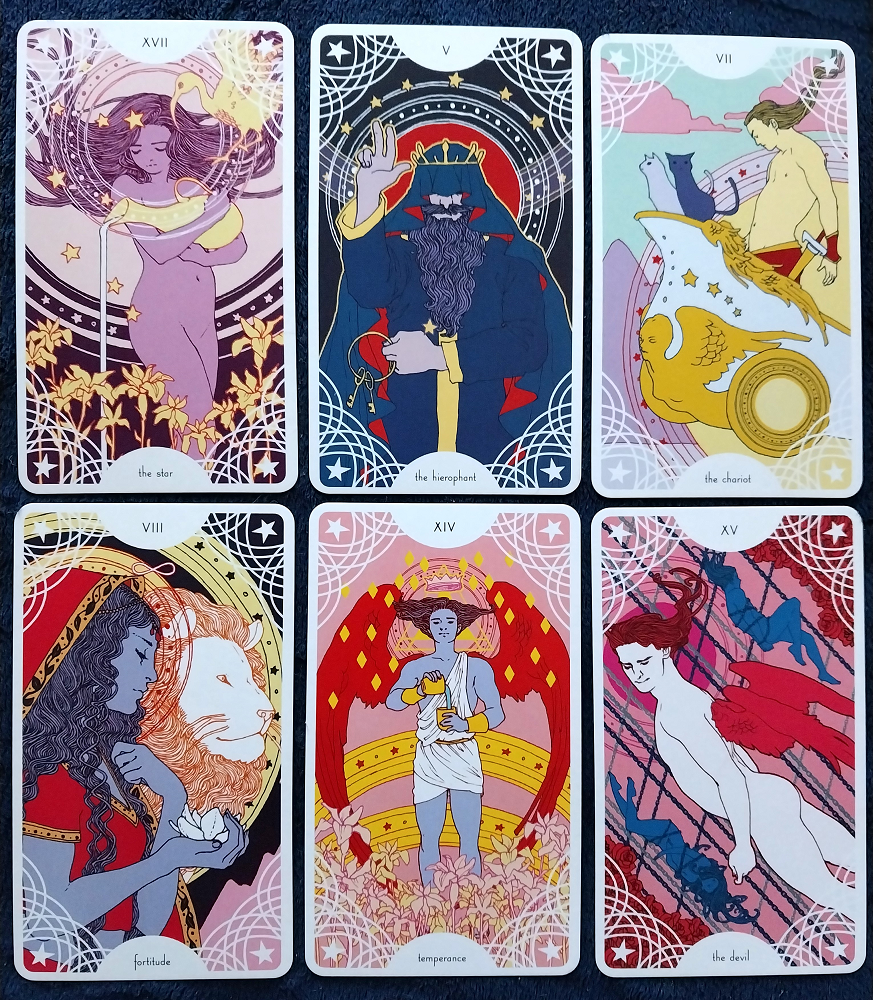
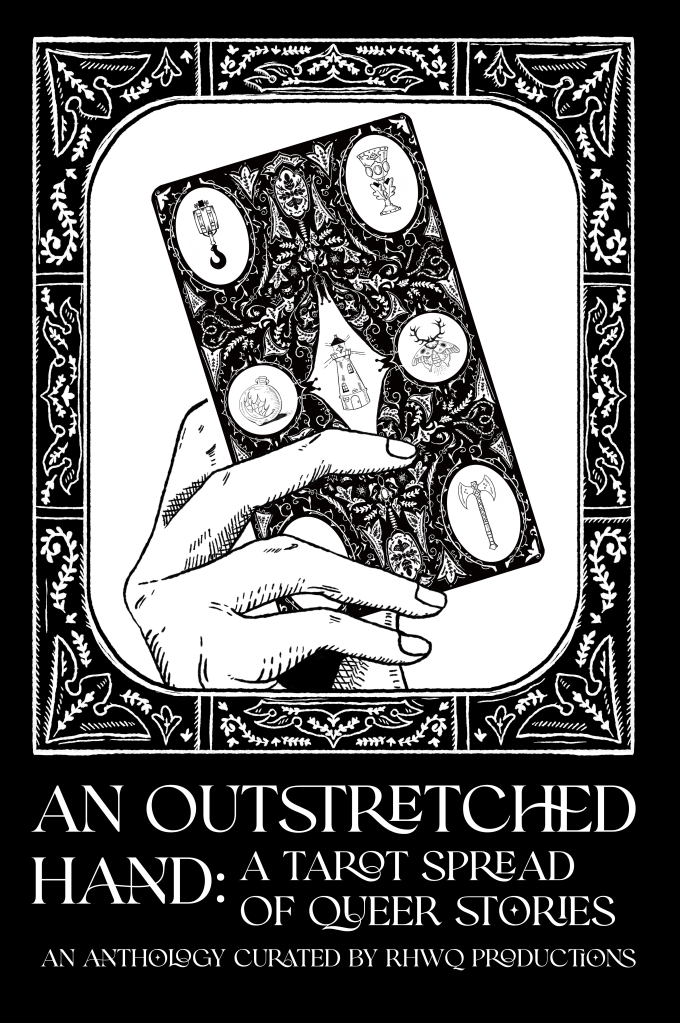
An Outstretched Hand: A Tarot Spread of Queer Stories is a fantasy anthology inspired by the magic of tarot, available now wherever fine books are found. The six tales include…

The Star by Tess Carletta

A lighthouse keeper who influences the fate of her people by wrangling misbehaving stars back into place must remedy her own constellation.

The Hierophant by Carolina Cruz

A knight who was disabled in battle gives up on asking the gods for healing and turns to something dark in the woods for help instead.

The Chariot by RK Ashwick

Two witches vie desperately for a goddess’s blessing—but the fortune they seek might be right in front of them.

Strength by Luna Daye

A warrior is sent to investigate the rumors of a raided village and is forced to face the trauma of his past, and has to battle more than his grief after a terrifying discovery.

Temperance by Noah Hawthorne

A grieving mercenery searches for the tallest mountain to throw himself from, but a mystery and curious folk keep him grounded for a little while longer.

The Devil by Sebastian Nothwell

A repressed Victorian finds fleeting release in a fae courtesan’s arms—until iron chains threaten their growing bond.

AmazonApple BooksBarnes & NobleBooks2ReadBookshop.orgKoboSmashwords

Appendicitis: The Narratively Perfect Disease – Hurt/Comfort

Disclaimer: I am not a doctor. None of this is medical advice. We are speaking of appendicitis in a purely fictional context. If you are having symptoms you suspect may be appendicitis please stop reading and seek medical attention from a qualified practitioner immediately.

~

“Four people are sitting around the table talking about baseball, whatever you like.

Five minutes of it, very dull.

Suddenly a bomb goes off. Blows the people to smithereens.

What do the audience have?

10 seconds of shock.

Now, take the same scene. And tell the audience that there’s a bomb under the table and that it’ll go off in 5 minutes.

Now the whole emotion of the audience is totally different. Because you’ve given them that information.

Now that conversation about baseball becomes very vital. Because they’re saying to you, don’t be ridiculous, stop talking about baseball there’s a bomb under there.

You’ve got the audience working.”

— Alfred Hitchcock

~

I hear Alfred Hitchcock talk about Suspense and I think Appendicitis. A bomb strapped under the table that only the audience can see? No—a vestigial organ in everyone’s abdomen.

Continue reading “Appendicitis: The Narratively Perfect Disease – Hurt/Comfort”

Hurt/Comfort – Why Do We Love This Trope?

“You construct intricate rituals which allow you to touch the skin of other men.”

–Barbara Kruger, Untitled, 1981

~

“In the war film, a soldier can hold his buddy—as long as his buddy is dying on the battlefield. In the western, Butch Cassidy can wash the Sundance Kid’s naked flesh—as long as it is wounded. In the boxing film, a trainer can rub the well-developed torso and sinewy back of his protege—as long as it is bruised. In the crime film, a mob lieutenant can embrace his boss like a lover—as long as he is riddled with bullets. Violence makes the homo-eroticism of many ‘male’ genres invisible; it is a structural mechanism of plausible deniability.”

Tarantino’s Incarnational Theology: Reservoir Dogs, Crucifixions, and Spectacular Violence. Kent L. Brintnall.

~

(Expanding on this reddit AMA and the Right Here Write Queer podcast episode with Luna Daye, Noah Hawthorne, Sarah Wallace, and S. O. Callahan.)

What is hurt/comfort?

In the simplest terms, hurt/comfort is any scene in a story wherein a character is hurt in some way and subsequently comforted.

Examples of hurt/comfort I’ve enjoyed in fiction include…

Our Flag Means Death, wherein a ferocious pirate captain tenderly looks after his wounded peer, well before any emotional connection has been established between them.

The Terror, wherein a steward nurses his captain through alcohol withdrawals (and—spoiler—is subsequently nursed through scurvy by his captain).

(“Hey, there seems to be a nautical theme here,” you say. Yes. Because of the unique homosocial setting of the Age of Sail removing women from the scene, which forces men to step up into a caretaking role for other men, and also because the isolation of a ship at sea means medical care—including surgery—must occur on location and often at the hands of characters who are already deeply intertwined. Also because I’m the one making this list and I have a problem.)

The trope is particularly popular in fanfiction, for reasons that will be expounded upon later. According to Fanlore, hurt/comfort dates back to the Star Trek fandom of the 1970s. (An earlier term for the trope was “Get ‘em,” as in “attack.” A hurt/comfort fanfic centered around Spock, for example, would be called a “get Spock” story.)

A related term, “whump,” has undergone a curious evolution. Originally it meant a more severe form of hurt/comfort, heavier on the hurt and with less comfort—sometimes even no comfort at all. More recently it has come to be almost synonymous with hurt/comfort; not necessarily because of any changing attitudes towards the trope itself, but simply that tagging systems on most social media platforms struggle to parse the slash in hurt/comfort without breaking the hashtag. (Only very recently has tumblr fixed this issue. Instagram and the like haven’t bothered.) This makes finding hurt/comfort posts on social media extremely difficult. However, since there is significant overlap between hurt/comfort and whump content, users were able to find hurt/comfort content through the whump tag, and so they merged.

In my own works, Fiorenzo has the most hurt/comfort per page; appendicitis, wild animal attack, kidnapping, stabbing, poisoning… the list goes on. Mr Warren’s Profession has its fair share in boiler explosions, burns, broken bones, and sundry others, with bonus pneumonia in its sequel Throw His Heart Over. Hold Fast features horse-riding accidents and gunshot wounds. The Haunting of Heatherhurst Hall has just as much gore as you’d expect from Gothic horror, but probably far more caretaking than most. As for Oak King Holly King, let’s just say, antler-induced migraines—plus hypothermia and still more wild animal attack in the sequel Tales from Blackthorn Briar. It’s fairly obvious that hurt/comfort is my favorite trope and I doubt I’ll ever craft a story without at least a drop of it.

But why?

What makes hurt/comfort so compelling?

For me, hurt/comfort is inextricable from queer romance—and more specifically, from romance between men.

Male characters in Western media generally aren’t permitted to be emotionally vulnerable towards other men. It seems like the only time a man can show weakness is if he’s physically wounded and/or dying.

After a lifetime of absorbing that, the end result is that physical vulnerability and emotional vulnerability go hand-in-hand in my brain.

Furthermore, there’s almost never any catharsis after a man is shown to be wounded in TV/film. We are shown the violence, and we are perhaps even shown the rescue from said violence, but the recovery is limited in scope if it is depicted at all. I find that very unsatisfying. And hurt/comfort is, for me, a satisfying way to dwell in the catharsis that is denied us when we are only shown the “hurt” half of masculine vulnerability.

(This lack of comfort in most media wherein characters are hurt is also why this trope is particularly prominent in fanfiction. Fanfic exists to fill the gaps in existing stories, and comfort is a very common gap.)

To be loved when you are weak, to not have to hide your suffering, to be honest about your pain and have your pain not just witnessed but also sympathized with and empathized with and to the extent that it is possible alleviated, is frankly an exhilarating prospect, and to see it occur in fiction can grant the reader a powerful euphoria.

Hurt/comfort is also very powerful from a technical standpoint as a writer. Your narrative voice can say your characters care about each other. You can even make the characters say it out loud themselves. But nothing will be as effective as showing that care through the characters’ actions, and it is the showing that will make it feel truly real to the reader. And nothing says “I care about you” quite like holding someone’s hair out of their face while they puke, or spoon-feeding them soup while they’re too weak with fever to do for themselves, or picking through the pus and gore to clean their wound and staunch their blood. It’s precisely this unglamorous side of true love that makes it believable. And it’s that believability that compels me far more than a thousand flowery declarations of eternal affection ever could.

What is revealed about a man who tries to keep his walls up but is forced into a position of vulnerability by his circumstances? What might his friend, lover, or even enemy learn of him then? Still more character is revealed in how they react to his plight. If he expects scorn as a reward for what he perceives as a failure of his strength, what would it do to him to receive compassion in its stead? What could this new understanding between them spark?

I write hurt/comfort to answer these questions and to achieve the catharsis denied to me in almost all other media. In a world full of hurt, we all need some comfort.

~

What is an Annotated Book?

If you’re a reader who abhors writing in books, turn back now.

The short definition of an annotated book is a book that contains additional details outside of the original text. This is often seen with reprinted “classics” of the Western literary canon, such as an edition of The Picture of Dorian Gray where the publisher has added footnotes explaining Oscar Wilde’s allusions to history, literature, and in some cases his own biography. Or, in a less illustrious example, my own annotated copy of the Sherlock Holmes novel The Sign of Four by Sir Arthur Conan Doyle, wherein a helpful footnote interrupted a thrilling boat chase to inform me that, “The Thames is a river in London.”*

However, preprinted annotations are not the only valid form of annotating books. Nor, to my mind, are they the most interesting.

Handwritten annotations by everyday readers are a long-standing human tradition which has rapidly increased in popularity of late. Readers have always enjoyed and continue to enjoy putting their own personal touches on their home libraries, including highlighting favorite passages and scribbling notes in the margins.

My grandfather was a voracious reader and annotator. Not only did he underline, asterisk, and write marginal notes in his copy of The Story of English, he also created a handwritten supplemental index at the back of the book. (Presumably the multi-page preprinted index the publishers provided was insufficient for his purposes.)

(Not shown: the obscure 20th century small press religious text wherein he underlined several passages and wrote over and over again in the margins, “Human sacrifice?”)

Another grandfather (not my own) created a singular annotation in his copy of Moby-Dick that nonetheless resonated with thousands of users on tumblr dot com.

More recently, annotating books has proved particularly popular in the Dark Academia subculture. The hobby reinforces many of the subculture’s values at the intersection of literature, curating a personal library, and following advice straight from Donna Tartt’s The Secret History: “It is is better to know one book intimately than a hundred superficially.”**

In the case of most public domain literature like Melville or Wilde, the reader is limited to either their own annotations or the annotations of whatever experts a given publishing company chooses to hire to produce preprinted notes for their particular special edition. We do not have the option of annotations from Melville or Wilde themselves as they are regrettably deceased.

This is not true of most books published in the 21st century. For a modern book with a living author, it’s now possible to attain handwritten annotations from the author themself on the text.

For example—in my annotations for Oak King Holly King, I explore the paragraphs of historical research behind single lines of dialogue, the queer connections between Chartism and the 1381 Peasant’s Revolt, and the secret origins of the ambassador (alias the spiderweb fae), alongside highlighting my own favorite passages and sundry other notes.

As well as a personalized autograph!

I’ve done the same for all my books, including…

Mr Warren’s Profession, wherein I divulge the symbolism in the menu of the Worst Dinner Party Ever and tell all about Rowena’s discreet sapphic flirtation methods.

Throw His Heart Over, wherein I get real nerdy about art history.

The Haunting of Heatherhurst Hall, wherein I wax poetical about New England folklore and sapphic literature.

Hold Fast, wherein I really let loose on the Moby-Dick and Poe allusions while tipping my hand when it comes to my fave characters.

Fiorenzo, wherein I finally (finally!!!) explain why the city is called Halcyon and why Fiore’s shipwrecked home is called the Kingfisher.

Tales from Blackthorn Briar, wherein I indulge in medieval trivia and rejoice in giving Mr Grigsby and Daniel the happily-ever-afters they so richly deserve.

…all of which you can find available for discerning and dedicated readers on my Etsy.

~

*Which in terms of Captain Obvious facts comes second only to my college oceanography textbook’s helpful tip: “The Indian Ocean is so named for its proximity to the subcontinent of India.”

**Whether this advice, like the bulk of the novel itself, is meant to be satirical… who can say.

Autism Representation (Accidental and Deliberate)

(This post inspired by a recent AMA on the MM_RomanceBooks subreddit.)

Mr Warren’s Profession is my first novel.

Perhaps because I felt insecure and thought I had something to prove, I was determined to depict two allistic protagonists. Then I handed it off to an allistic friend for a beta read, who said, “Wow! It’s so cool how you’re doing autistic representation by having two autistic characters in a romance together!”

Which told me I was even worse at masking than I’d thought.

Continue reading “Autism Representation (Accidental and Deliberate)”

How do you defeat writer’s block?

Everyone has those days when they show up and sit down to write and their brain, for whatever reason, just says, “I can’t.”

For years I didn’t have a solution to this problem beyond beating my head against the keyboard until a few paltry words fell out.

Then, as I walked away from another disappointing writing session with my brain chanting, “I can’t, I can’t, I can’t…” I stopped and said to myself, “Okay. I can’t write today. But if I could, what would I write?”

And suddenly there burst forth a flood of fresh ideas, dialogue, and fully-formed prose that sent me scurrying back to my keyboard to write it all down.

Rather than arguing with my insecurities and defeatism, I’ve found that allowing myself to have those feelings rather than denying them – and following up with the gentle question of, “What if we could, what would we do?” – can trick my brain into working again.

Will this work for you? I don’t know. You don’t have my brain and I don’t have yours. But for me, tricking myself into treating it as a thought exercise rather than wallowing in personal failure has instantly unblocked me more times than I can count.

What about you? How do you defeat writer’s block?

The Ballad of Daniel Durst, or; What’s in a Name?

Some character names come unbidden. Others are agonized over.

For Aubrey and Lindsey of Mr Warren’s Profession, it was very simple. I have a lifelong fascination with the arbitrary gendering of names and how a name’s gender can change throughout history. Many names we consider “feminine” today were often “masculine” in earlier centuries. The name Aubrey, for example, was used almost exclusively for boys until the song “Aubrey” by Bread hit the radio in 1973. The lyrics even remark upon the name being unusual for a girl.

And Aubrey was her name
A not so very ordinary girl or name
But who’s to blame?

Cue millions of girls born throughout the 70s and 80s getting the name Aubrey.

But before Bread, there was Beardsley. Specifically Aubrey Beardsley, a late Victorian artist who leant his pen-and-ink talents to illustrating, among other things, Oscar Wilde’s Salome. It is in his honour that Aubrey Warren is named Aubrey.

With Aubrey settled, his soulmate still required a name. I ran down my list of Victorian masculine names that had since leapt over to femininity and settled on Lindsey. Simple and satisfying.

For Hold Fast, I wanted to continue my habit of granting my masculine heroes names which had shifted from 19th century masculinity to 20th and 21st century femininity. Evelyn, absolutely unapologetic about who and what he is, received a name now considered unambigiously feminine. Morgan, however, keeping his true desires hidden not just from the world around him but also arguably from himself, received a name that still retains its gender ambiguity.

The protagonists of The Haunting of Heatherhurst Hall received the same treatment in reverse. The name Catherine has (to the best of my knowledge) always been considered feminine. Kit, however, is a nickname fit for anyone regardless of gender. And the genderless ambiguity of Alex as a nickname for Alexandra, Alexander, and any variation thereof, is almost a cultural meme.

And now we come to Oak King Holly King.

I struggled for ages with what to call the heroes of Oak King Holly King. One was a mortal clerk, the other a fae warrior. I knew I wanted the fae to have a name from the natural world. Beyond that I was stumped.

After hours of deliberation I finally decided I would give one character the name Wren, it being both a delightful bird and also a common enough given name for humans.

Unfortunately I originally assigned it to the fae.

It felt wrong from the start. Yes, the fae was fierce like a wren. But beyond that it didn’t sit right. And I still had no name for his mortal counterpart.

One morning, tearing my hair out over my laptop, I realised that if Wren was a good name for a human in my world, then it would probably suit a Victorian mortal. So I slapped the name Wren onto my mortal clerk and it stuck. Suddenly his character clarified; a wee speckled figure who appeared docile at first glance but would loudly and fiercely defend itself and its territory at the slightest provocation.

And since I already had a bird theme going, it seemed only natural to continue it and call the fae Shrike. This likewise gave both character and story the vital direction they’d lacked. An established method of attack (skewering), a particular appearance (masked), and a preferred habitat (thorns).

Naming the characters unstuck the story’s wheels and allowed it to roll out into the book you know now. Secondary characters came still easier. Daniel’s name is a reference to the BBC’s 2012 miniseries adaptation of The Mystery of Edwin Drood by Charles Dickens. In a blink-and-you’ll-miss-it moment where the camera pans over the sign beside Mr Grewgious’s door, it reveals his clerk’s name as Daniel Bazzard. (Dickens himself never bothered to grant Bazzard a given name). Sukie is even more straightforward; I named her after my favorite character from Gilmore Girls.

I delved back into the world of Oak King Holly King to write its sequels in Tales from Blackthorn Briar. Daniel would finally be the protagonist of his own story. As I began writing The Ballad of Daniel Durst, I realised I knew Sukie was a nickname for something, but had no idea which name it came from.

Enter Behind the Name, one of my favorite websites for researching and collecting names for characters.

Looking up Sukie on Behind the Name revealed it was a nickname for Susan, derived from the Biblical name Susanna. In the story of Susanna and the Elders, the innocent Susanna is accosted by two lecherous old men. When she refuses them, they accuse her of adultery in revenge. She is arrested and about to be executed when a young man speaks up and demands her accusers be questioned. The elders are interrogated separately, which reveals a massive hole in their false story; one claims Susanna met her fictional lover beneath a mastic tree, and the other claims to have seen her with her fictional lover beneath an oak. As Wikipedia puts it:

“The great difference in size between a mastic and an oak makes the elders’ lie plain to all the observers. The false accusers are put to death, and virtue triumphs.”

Why repeat all this? Because the young man who spoke up in Susanna’s defense was named Daniel.

I had no idea of this connection when I originally named and wrote these characters. In retrospect it feels like fate. Their roles in Oak King Holly King and The Ballad of Daniel Durst are reversed; it is Sukie who helps rescue Daniel from the unwelcome advances of a lecherous elder. And through that rescue both Sukie and Daniel are able to find their happily-ever-after with each other.

~

Tales from Blackthorn Briar is the sequel to Oak King Holly King, featuring hurt/comfort and many happily-ever-afters – available now wherever fine books are found!

Shrike, the fae Butcher of Blackthorn, and Wren Lofthouse, a mortal Victorian clerk, are bound together by love and fate. Their continued adventures (and those of their friends) are told in this collection of fantastical tales following the story of Oak King Holly King, including…

Mabon
• Wherein Shrike and Wren repay their debt to the Court of Hidden Folk.

Mr Grigsby’s Clerk
• Wherein Mr Grigsby finds a replacement for Wren – and perhaps more than he bargained for.

Jack in the Green
• Wherein a certain Horse Guard wanders into Blackthorn Briar.

Winter Solstice
• Wherein the Holly King surrenders to the Oak King.

The Holly King’s Peril
• Wherein Wren and Shrike discover danger in the wilds of the Fae Realms.

The Ballad of Daniel Durst
• Wherein Daniel embarks on his authentic life in a bold new land.

AmazonApple BooksBarnes & NobleKoboScribdSmashwords

New Cover Reveal! Mr Warren’s Profession

     “It took some time for me to bring myself to try reading just a sample of this novel. The reason being, the cover page is so awful and ugly. The art work is just totally off-putting. It’s as if the publisher deliberately is trying to turn off readers. HOWEVER, the novel is wonderfully written. It is such an unexpected surprise that I would unequivocally recommend this novel to all.”
               — J Kevin Barry

     “It is a really great book. Disregard the cover and try it. […] I wouldn’t be the first to the mention the cover. I accept it has a quaintness, but I am not partial to to the artwork. I didn’t like it before reading the story, and as such, went into this not expecting much from the story other than a light read. Instead, I was totally charmed.”
               — Reflection

     “like i thought the cover looked kinda goofy so i was a little reluctant to start, but i’m so glad i trusted the premise and got started on it because i got totally hooked and binged most of it in two days.”
               — The Knights Who Say Book

     “Ignore the Cover, Read the Book! This is a book which I passed by several times because of the cover.”
              — Bo

     “I will say though that i nearly did not read it. shallow as I am, the book cover was not appealing. just goes to show, never judge a book by its cover…or something like that…”
              — Patdbooks

     “I thought the cover was a bit off putting – Mr Warren looks like an unattractive gnome!”
                — Sally

     “Although others like the cover art, I found it distracting because both men are supposedly far more attractive than this is.”
               — Rhode

     “Truth be told – DON’T judge this book by its cover! […] I rather like the cover art and understand why it’s used, but I add the disclaimer at the beginning of this review because I can imagine (perhaps in error) that some potential readers might interpret the style as frivolous, too old-school, as indicating that the book is a parody or even conservative.”
                — R E

     “This book first attracted my attention when I saw it ‘compared’ (associated?) with North and South by Elizabeth Gaskell. I love that book and the idea of an m/m version of it was so intriguing, that not even Mr Warren’s Profession’s cover could dissuade me from giving this a try.”
               — Elena

     “Terrible cover, great book.”
              — Jane Harper

It is a truth universally acknowledged that when so many otherwise positive reviews mention how much they hate the book’s cover, the author might do well to consider changing it.

Mr Warren’s Profession is my first published novel. When I sent it out into the world, I knew absolutely nothing about cover design. I think that much is evident from the typography. I did it myself, and boy howdy, it shows. (Note to Sebastian of the past: adding a white drop shadow will not fix black text over a black top hat.)

mr_warrens_profession

And so, in the hopes that readers might be able to recommend the book without a cover caveat, I contacted two talented professionals to help fix the issue.

The first, Jann of Thistle Arts Studio, is a fantastic painter. You can see further examples of his work on his Instagram, Patreon, and Etsy. (Warning: NSFW!) You’ll see more of it when Oak King Holly King is finally released. But for now, he has created a brand new cover painting for Mr Warren’s Profession.

The second, Kelley of Sleepy Fox Studios, is a mastermind of cover composition and typography. You’ve already seen her work on the cover for Hold Fast, which received a quiet redesign about a year ago. You’ll see it again when Oak King Holly King is finally released, and you’ll see it very shortly on the brand new cover design for Mr Warren’s Profession.

And now, without further ado: the new cover. I do hope you approve, and that Aubrey and Lindsey are finally as handsome in pictures as they are in words.

Continue reading “New Cover Reveal! Mr Warren’s Profession”

“A Happy Ending Was Imperative”; what romance means for the LGBT+

“A happy ending was imperative. I shouldn’t have bothered to write otherwise.”

— E. M. Forster, Maurice, Terminal Note

Romance as a genre has two simple prerequisites. First, that the central plot of the story must revolve around a romantic relationship. Second, it must have a happy ending—at least happy-for-now, if not happily-ever-after.

These two prerequisites are absent from most fiction about the LGBT community.

Mainstream LGBT fiction, particularly literary fiction and YA fiction, is often praised for its “realism.” “Realism,” in this case, is code for “ends badly.” (For more on the realism of HEAs in historical romance specifically, please check out KJ Charles’s excellent post, Historical Romance: Who Gets the HEA.)

In the best case scenario, if a LGBT couple exists at all, they will break up before the end of the story. In the more common scenario, at least one of the LGBT characters dies. TVTropes calls this phenomenon “Bury Your Gays”—and yes, it happens often enough to have a trope name all its own.

E. M. Forster observed this phenomenon as well in his Terminal Note to Maurice. Maurice is a novel with a very simple story; a man who is attracted to men falls in love with a particular man and they live happily ever after. Though Forster began writing the novel in 1913 and finished it 1914, by the time he wrote its Terminal Note in 1960 it remained unpublished and unread by all except a few of his close friends. The reason for this, in his own words, is the happy ending—his motivation for writing the book in the first place.

While the United Kingdom rolled back the death penalty for sodomy in 1861 (changing the punishment to mere life imprisonment), the Labouchere Amendment of 1885 expanded the crime of homosexuality to include any “indecent acts” between men—with an absurdly low burden of proof. Every token of affection between men was now punishable by two years of hard labor in prison.

Homosexuality remained a criminal offense in the United Kingdom until 1967—seven years after E. M. Forster wrote the Terminal Note for Maurice. Maurice itself wasn’t published until after the author’s death in 1971. Because of the legal status of homosexuality in England at that time, no publisher would touch Maurice before then, even though its author had already produced such literary feats as A Room with a View and A Passage to India.

Or, in E. M. Forster’s own words:

“If it ended unhappily, with a lad dangling from a noose or with a suicide pact, all would be well, for there is no pornography or seduction of minors. But the lovers get away unpunished and consequently recommend crime. […] the only penalty society exacts is an exile they gladly embrace.”

On the few occasions that LGBT characters exist in fiction, they are even more rarely the heroes. Throughout the 20th century they were most often cast as villains, with a trend towards comic-relief sidekick at both the beginning and end of that century, if they appeared at all. Their romance, assuming it exists in-text and is not merely divulged through the author’s Twitter post-publication, is by no means central to the story, may be easily deleted for homophobic markets, and has little to no effect on the character’s life, much less the plot.

Only recently—and by “recently,” I mean “within the last five years,” has the tide begun to turn.

The romance genre helps turn this tide. After all, a romantic relationship must be the core of a romance novel. If one writes a gay romance, one cannot merely hint that the heroes are romantically interested in each other. It must be readily apparent to the reader, otherwise there is no story.

Likewise, a romance must have a happy ending. Therefore, if we continue with our example of a gay romance, neither hero can die at the end. Nor can they deny they ever felt any attraction to each other. They cannot break up. They cannot commit suicide. They must continue on living together in romantic bliss—or, as E. M. Forster put it,

“I was determined that in fiction anyway two men should fall in love and remain in it for the ever and ever that fiction allows, and in this sense Maurice and Alec still roam the greenwood.”

And, despite ongoing persecution from the outside world, there is a great wealth of historical evidence in favor of LGBT happily-ever-afters.

Edward Carpenter and George Merrill, for example, were not only life partners but gay rights activists in the late 19th and early 20th centuries. Neither man went to prison for “indecent acts,” despite their living together as a couple deeply in love—possibly they escaped such persecution due to their self-imposed exile from society on their shared farm. They were together for 37 years, from their first meeting in 1891 until George Merrill’s death in 1928. It is their real-life love story that inspired E. M. Forster to write Maurice—and Forster’s longing, as a gay man, for a happily-ever-after of his own that demanded Maurice end in the same bliss.

Much like Forster, I don’t see the point in writing if I can’t give my protagonists a happy ending.

My personal goal, as an author, is to keep writing happily-ever-afters for LGBT characters until their number equals all the LGBT tragedies and all the straight happily-ever-afters combined.

I recognize that this is an unlikely goal, and so will content myself with writing until my hands fall off.

~

An earlier version of this article appeared in the Rhode Island Romance Writers monthly newsletter.