There’s a new episode of Right Here Write Queer waiting for you in your favorite podcast app!
Tess Carletta (she/her) interviews Sebastian Nothwell (he/him) about his gay romance novel Mr Warren’s Profession, including historical research, Victorian engineering, and the strange and stubborn road to indie publishing.
Tess Carletta (she/her) is the author of Kit & Basie, a queer cozy magical-realism romance. You can connect with her at her website: tesscarletta.com
Sebastian Nothwell (he/him) is the author of Mr Warren’s Profession, a queer historical romance currently crowdfunding its audiobook. You can check out the campaign on Kickstarter.
If you’re a reader who abhors writing in books, turn back now.
The short definition of an annotated book is a book that contains additional details outside of the original text. This is often seen with reprinted “classics” of the Western literary canon, such as an edition of The Picture of Dorian Gray where the publisher has added footnotes explaining Oscar Wilde’s allusions to history, literature, and in some cases his own biography. Or, in a less illustrious example, my own annotated copy of the Sherlock Holmes novel The Sign of Four by Sir Arthur Conan Doyle, wherein a helpful footnote interrupted a thrilling boat chase to inform me that, “The Thames is a river in London.”*
However, preprinted annotations are not the only valid form of annotating books. Nor, to my mind, are they the most interesting.
Handwritten annotations by everyday readers are a long-standing human tradition which has rapidly increased in popularity of late. Readers have always enjoyed and continue to enjoy putting their own personal touches on their home libraries, including highlighting favorite passages and scribbling notes in the margins.
My grandfather was a voracious reader and annotator. Not only did he underline, asterisk, and write marginal notes in his copy of The Story of English, he also created a handwritten supplemental index at the back of the book. (Presumably the multi-page preprinted index the publishers provided was insufficient for his purposes.)
(Not shown: the obscure 20th century small press religious text wherein he underlined several passages and wrote over and over again in the margins, “Human sacrifice?”)
More recently, annotating books has proved particularly popular in the Dark Academia subculture. The hobby reinforces many of the subculture’s values at the intersection of literature, curating a personal library, and following advice straight from Donna Tartt’s The Secret History: “It is is better to know one book intimately than a hundred superficially.”**
In the case of most public domain literature like Melville or Wilde, the reader is limited to either their own annotations or the annotations of whatever experts a given publishing company chooses to hire to produce preprinted notes for their particular special edition. We do not have the option of annotations from Melville or Wilde themselves as they are regrettably deceased.
This is not true of most books published in the 21st century. For a modern book with a living author, it’s now possible to attain handwritten annotations from the author themself on the text.
For example—in my annotations for Oak King Holly King, I explore the paragraphs of historical research behind single lines of dialogue, the queer connections between Chartism and the 1381 Peasant’s Revolt, and the secret origins of the ambassador (alias the spiderweb fae), alongside highlighting my own favorite passages and sundry other notes.
As well as a personalized autograph!
I’ve done the same for all my books, including…
Mr Warren’s Profession, wherein I divulge the symbolism in the menu of the Worst Dinner Party Ever and tell all about Rowena’s discreet sapphic flirtation methods.
Hold Fast, wherein I really let loose on the Moby-Dick and Poe allusions while tipping my hand when it comes to my fave characters.
Fiorenzo, wherein I finally (finally!!!) explain why the city is called Halcyon and why Fiore’s shipwrecked home is called the Kingfisher.
Tales from Blackthorn Briar, wherein I indulge in medieval trivia and rejoice in giving Mr Grigsby and Daniel the happily-ever-afters they so richly deserve.
…all of which you can find available for discerning and dedicated readers on my Etsy.
~
*Which in terms of Captain Obvious facts comes second only to my college oceanography textbook’s helpful tip: “The Indian Ocean is so named for its proximity to the subcontinent of India.”
**Whether this advice, like the bulk of the novel itself, is meant to be satirical… who can say.
Now that funding, production, and distribution for Oak King Holly King is all wrapped up…
It’s time for another audiobook.
Mr Warren’s Profession is a queer historical cross-class romance featuring hurt/comfort and a happily-ever-after. I’m so excited to be teaming up with Gary Furlong once again to bring it to life.
The Mr Warren’s Profession audiobook Kickstarter will kick off on September 1st. If you want to be notified when it does, you can check out the pre-launch page here!
A new episode of Right Here, Write Queer just dropped! Catch it in your favorite podcast app.
“Big guys that stab things also deserve to be soft and squishy.” Noah Hawthorne (he/they) interviews Sebastian Nothwell (he/him) about his queer romantasy Oak King Holly King, including historical research, fae folklore new and old, and the surprising discoveries that occur when creating an audiobook.
Noah Hawthorne (he/they), also writing as Aelina Isaacs, is the author of the Adventures in Levena series (beginning with Phantom and Rook) and the stand alone novel The Rebel Foxes. You can connect with him at their website: neshamapublishing.com
Sebastian Nothwell (he/him) is the author of Oak King Holly King, now available in audiobook format narrated by Gary Furlong.
The Oak King Holly King audiobook is finally here! Narrated by the incredible Gary Furlong and available wherever you find your favorite audiobooks, be it Audible, Spotify, libro.fm, Kobo, or through your local library via Libby and Hoopla.
Oak King Holly King is a queer romantasy wherein a fearsome fae warrior destined for ritual sacrifice seeks a Victorian clerk fated to save him.
Perfect for readers who enjoy… • fae folklore • Victorian shenanigans • big buff guys who just wanna be soft • sharp little guys who are tired of being kicked around • lush fantasy worlds, liminal spaces, cozy cottagecore vibes, and queer community.
Shrike, the Butcher of Blackthorn, is a legendary warrior of the fae realms. When he wins a tournament in the Court of the Silver Wheel, its queen names him her Oak King – a figurehead destined to die in a ritual duel to invoke the change of seasons. Shrike is determined to survive. Even if it means he must put his heart as well as his life into a mere mortal’s hands.
Wren Lofthouse, a London clerk, has long ago resigned himself to a life of tedium and given up his fanciful dreams. When a medieval-looking brute arrives at his office to murmur of destiny, he’s inclined to think his old enemies are playing an elaborate prank. Still, he can’t help feeling intrigued by the bizarre-yet-handsome stranger and his fantastical ramblings, whose presence stirs up emotions Wren has tried to lock away in the withered husk of his heart.
As Shrike whisks Wren away to a world of Wild Hunts and arcane rites, Wren is freed from the repression of Victorian society. But both the fae and mortal realms prove treacherous to their growing bond. Wren and Shrike must fight side-by-side to see who will claim victory – Oak King or Holly King.
A new episode of Right Here, Write Queer just dropped! You can listen in your favorite podcast app.
On today’s episode, four indie authors discuss the how and why of audiobook production – including accessibility, distribution, funding, surprises, pitfalls, and the joys of collaborating with human narrators. Plus, the true cost of paperbacks.
Noah Hawthorne (he/they), also writing as Aelina Isaacs, is the author of Phantom and Rook, narrated by Kirt Graves.
Sarah Wallace (they/she) is the author of Letters to Half Moon Street, narrated by Gregory Maupin and Abigail Bailey Maupin, and co-author of Breeze Spells & Bridegrooms, narrated by Matt Simpson.
S.O. Callahan (she/her) is the co-author of Breeze Spells & Bridegrooms, narrated by Matt Simpson.
Sebastian Nothwell (he/him) is the author of Oak King Holly King, narrated by Gary Furlong.
Please enjoy this sneak peek inside the Oak King Holly King audiobook!
Gary Furlong has graciously given permission to share his audition audio. This excerpt in particular allows you to hear his skillful approach to a voice that – those of you who’ve read the book will know – is more important than it may at first appear.
And if you’d like to hear Gary narrate the rest of the book, you’ve got just four days left to back the Kickstarter!
Oak King Holly King is a queer Victorian fantasy romance between a fae warrior and a mortal clerk.
Perfect for readers who enjoy…
fae folklore
Victorian shenanigans
big buff guys who just wanna be soft
sharp little guys who are tired of being kicked around
lush fantasy worlds, liminal spaces, cozy cottagecore vibes, and queer community.
Our audiobook narrator is Gary Furlong. If you’re a queer romance audiobook enthusiast you may recognize him from…
The Secret Casebook of Simon Feximal by KJ Charles
The Ruin of a Rake by Cat Sebastian
The Soldier’s Scoundrel by Cat Sebastian
The Lawrence Browne Affair by Cat Sebastian
To claim your copy of the audiobook (alongside rewards like stickers, deep-discounted ebooks, and signed and annotated paperbacks), back the Kickstarter campaign today!
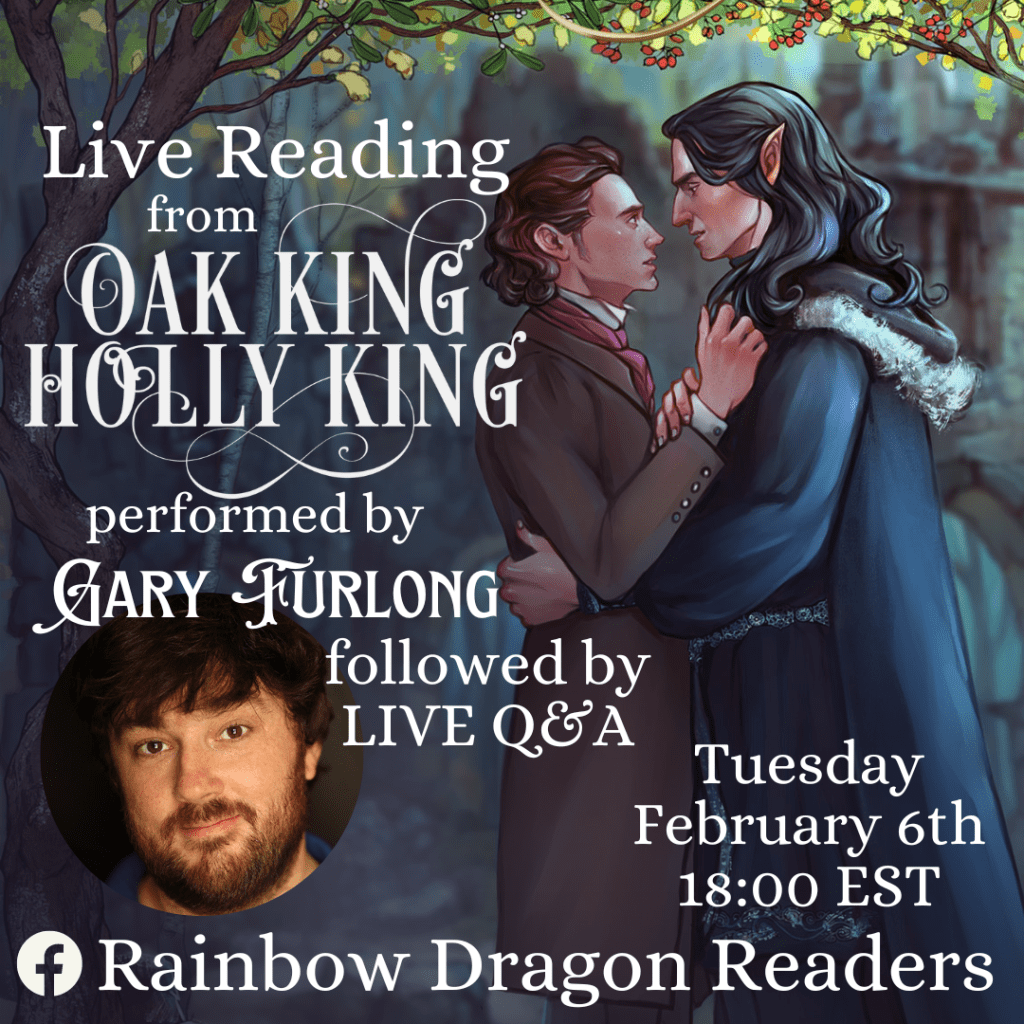
Save the date! Gary Furlong and I are going live tomorrow in the Rainbow Dragon Readers facebook group to bring you a live reading from Oak King Holly King followed by a live Q&A.
Thanks to Kirt Graves and Maz Maddox for inviting me on to their podcast Hoof & Fang! Had a delightful time chatting with them about queer history and Victorian solarpunk.
And please check out their Patreon for queer audiobooks!



 Sebastian Nothwell